How can a severely sensitized stainless steel be desensitized without any heat treatment?
In a recent study by Sasidhar et al. (2025), ultrasonic nanocrystalline surface modification (UNSM) was shown to restore corrosion resistance in sensitized AISI 304H stainless steel through a fundamentally new, mechanically driven mechanism. Using Atom Probe Tomography (APT), the authors revealed nanoscale chromium homogenization occurring at room temperature, without dissolving chromium carbides.
The Challenge of Sensitization
Sensitization occurs when chromium carbides precipitate along grain boundaries, locally depleting chromium below the ~11 at.% required for passivation. These chromium-poor regions are highly susceptible to intergranular corrosion. Traditionally, desensitization requires prolonged high-temperature annealing to restore chromium homogeneity, or the components need to be replaced before failure. The environmentally sensitized steels in this study were subjected to standard salt baths demonstrating their susceptibility to corrosion.
High Strain-Rate Surface Modification with UNSM and the Mechanisms for Repair
UNSM introduces severe plastic deformation at strain rates exceeding 10^4–10^5 s⁻¹. Cross-sectional Transmission Electron Microscopy (TEM) shows a heavily deformed near-surface layer extending ~400 µm below the surface, including nanocrystalline regions, deformation twins, and strain-induced martensite.
APT analysis of the sensitized material reveals chromium concentrations dropping to ~7 at.% adjacent to grain-boundary carbides. After UNSM treatment, the carbides remain intact, but the minimum chromium concentration in the surrounding matrix increases to ~11 at.%, restoring passivity.

Fig. 1. APT results of the UNSM-treated steel extracted from a depth of about 80 nm below the surface. (a), Three-dimensional reconstruction of the sample showing the detected carbon atoms and a 3 at.% carbon iso-concentration surface, revealing chromium carbide precipitates fragmented upon deformation. Region Of Interest (ROI) in blue. (b) Compositional distribution along the ROI. The matrix has been returned to approximately ~12 at. % Cr in the treated steel, but not due to loss of Chromium from the carbide.
Chromium iso-concentration surfaces undergo a marked transformation after UNSM. Instead of planar diffusion-driven profiles, the distributions become faceted and aligned with crystallographic directions. Correlative APT/TEM analysis connects these features to deformation twins, pointing to chromium transport along Shockley twin boundaries.
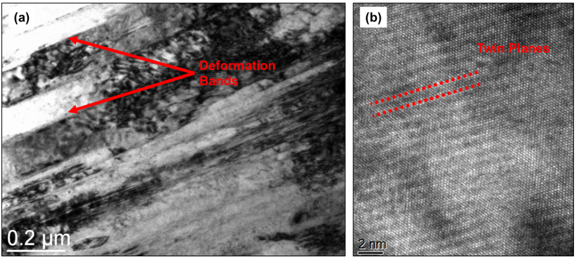
Fig. 2. (a) The microstructure at this location is composed of a high number density of parallel deformation bands in the grain interiors. (b) A high-resolution TEM image from within one of the deformation bands providing direct evidence for the presence of a high number density of nano-twins. Some of the twinning planes have been highlighted by red dotted lines.
Why This Matters
This work demonstrates a new pathway for desensitizing stainless steels without heat treatment. More broadly, it highlights how severe mechanical deformation can be used as a tool for nanoscale chemical engineering and how APT uniquely enables direct visualization of these effects.
Learn more about the APT technique and CAMECA's instruments by visiting
CAMECA's APT Overview.
Authors: Robert Ulfig (Senior Applications & Business Developer)
Summarized from: Sasidhar, K. N., Ulfig, R. & Sridharan, K. Nanoscale Compositional Homogenization by Severe Plastic Deformation-Induced Twinning for Achieving Desensitization in Stainless Steel. Metall Mater Trans A 56, 1572–1584 (2025).