Understanding how long proteins survive in our muscles is a key question in biology, aging research, and medical science. In cardiac and skeletal muscles, systems that operate continuously throughout life, maintaining protein integrity is critical.
Recent advances combining Secondary Ion Mass Spectrometry (SIMS), proteomics, and stable isotope labeling are now revealing not only how quickly proteins are renewed, but also where older proteins persist within tissues.
This breakthrough provides new insights into muscle aging, protein turnover, and cellular health.
What Is Protein Turnover and Why Is It Important for Muscle Health?
Protein turnover refers to the continuous cycle of protein synthesis and degradation. It is essential for maintaining cell function, especially in long-lived cells such as muscle fibers.
Each protein has a specific
half-life, which varies depending on:
- Tissue type (cardiac vs skeletal muscle)
- Cellular environment
- Functional role within the cell
Efficient protein turnover is crucial for:
- Preventing the accumulation of damaged proteins
- Supporting muscle function and repair
- Maintaining long-term cellular stability
Disruptions in this balance are strongly linked to
aging, muscle degeneration, and cardiovascular diseases.
SIMS Imaging: A Game-Changer for Studying Muscle Protein Aging
Traditional proteomics techniques measure protein turnover across entire tissues but lack spatial resolution. This means they cannot identify where older proteins are located inside cells.
Secondary Ion Mass Spectrometry (SIMS) changes this completely.
By combining:
- Stable isotope labeling
- Multi-isotope imaging mass spectrometry (SIMS)
researchers can now visualize protein age directly within tissue samples.
SIMS enables:
- High-resolution imaging of isotope distribution down to 30 nm
- Mapping of old vs newly synthesized proteins by dedicated 14N diet on 15N rich pups
- Detection of protein age at tissue, cellular, and subcellular levels by image from 10X10 µm2 to 1 mm2 field of view
This makes SIMS a powerful tool for
spatial biology and extend proteomic research to the single cell level
Different Muscles, Different Protein Lifetimes
By feeding
15N-pure mice, and then introducing a
14N -rich diet, the variation in
15N/
14N in cell measured by
NanoSIMS will reveal the turnover:
- Low 15N/14N, fast turnover, protein are renewed at a high rate
- High 15N/14N, slow turnover, protein are renewed at a low rate
One of the most impactful findings from this research is that
protein turnover varies significantly across muscle types:
- Cardiac muscle (heart) → fastest protein turnover with the lowest 15N/14N
- Slow-twitch skeletal muscle → intermediate turnover
- Fast-twitch skeletal muscle → slowest turnover with the highest 15N/14N
These differences are largely driven by
functional demand and muscle activity, rather than protein composition alone.
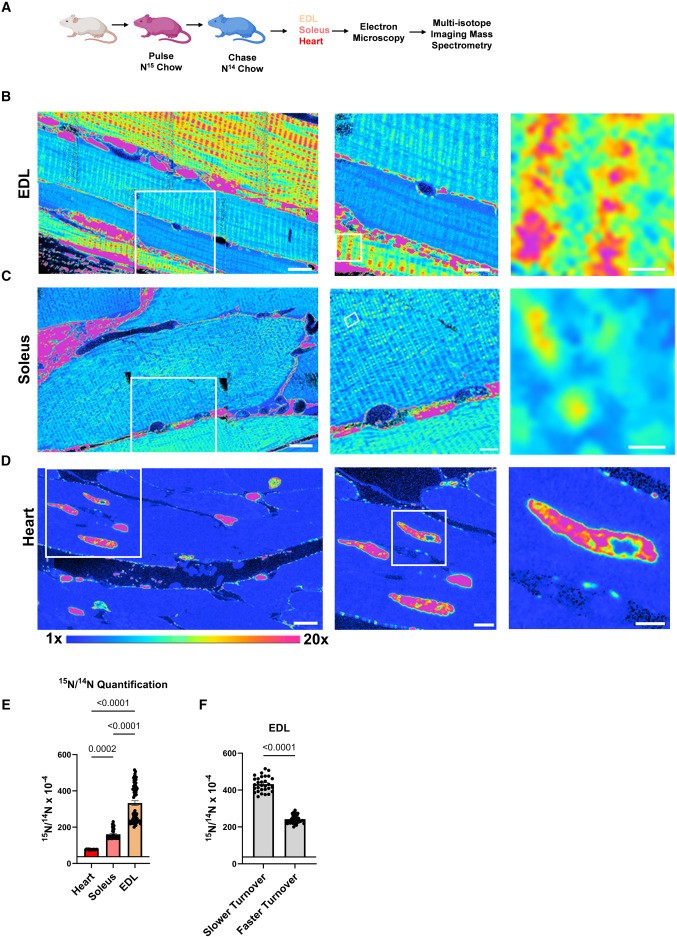
Fig. Protein age heterogeneity at the muscle and myofiber levels Age heterogeneity at the muscle and myofiber levels.
(A) Schematic showing pulse-chase labeling method for mice. (B–D) Representative MIMS images from the (B) EDL (scale bars: 10, 5, and 0.5 μm left to right), (C) soleus (scale bars: 10, 5, and 0.5 left to right), and (D) heart (scale bars, 10, 5, and 2.5 μm left to right). Color gradient represents 15N/14N ratio with blue indicating 1× background 15N/14N (37 × 10−4) and magenta indicating 20× background 15N/14N (740 × 10−4). (E) Quantification of 15N/14N ratio in the heart, EDL, and soleus. Each point represents one skeletal myofiber or cardiomyocyte from a separate image. Statistical analysis was performed with an ordinary one-way ANOVA. (F) Classification of fibers into “fast turnover” and “slow turnover” subpopulations using k-means clustering based on 15N/14N ratio. Statistical analyses were performed by t test with Welch’s correction. Center and error bars represent mean ± SEM.
Protein Age Is Not Uniform: Discovering Cellular Heterogeneity
A major discovery enabled by SIMS is that protein age is not evenly distributed, even within a single muscle cell.
Researchers observed:
- Regions rich in new proteins
- Areas where older proteins persist for extended periods
This heterogeneity appears at multiple scales:
- Across tissues
- Between muscle fibers
- Within subcellular structures such as sarcomeres
These results suggest that cells selectively regulate protein renewal depending on structural and functional needs.
Implications for Aging, Disease, and Therapeutic Strategies
Understanding protein longevity is essential for tackling major biological and medical challenges, including:
Aging and Longevity
Protein turnover is closely linked to organism lifespan and cellular aging mechanisms.
Muscle Degeneration and Sarcopenia
Altered turnover can lead to the accumulation of damaged proteins and loss of muscle function.
Cardiovascular Diseases
Maintaining proteome integrity is critical for long-term heart function.
Drug Development and Regenerative Medicine
Targeting protein turnover pathways could open new therapeutic strategies.
By adding spatial information, SIMS enables researchers to better understand where these processes occur, improving the precision of future treatments.
Why SIMS Is Essential for Modern Proteomics and Life Sciences
SIMS offers unique capabilities that complement traditional mass spectrometry:
- Spatially resolved isotopic imaging
- Subcellular resolution
- Visualization of protein age and turnover
- Insight into tissue heterogeneity
- Confirm proteomics measurements
This positions SIMS as a
key technology for studying complex biological systems, aging, and disease mechanisms.
A New Era for Muscle Biology and Protein Turnover Research
The combination of
SIMS imaging, stable isotope labeling, and proteomics is transforming our understanding of muscle biology.
By revealing both the
dynamics and spatial organization of protein turnover, researchers can now better understand how muscles function, age, and adapt.
These discoveries not only advance fundamental science but also pave the way for
innovative approaches to treating age-related diseases and improving human health.
For more information:
👉 Read the original article
Read the scientific article: Gugel, J., Currie, J., Alamillo, L., Flint, J., Kim, K.-Y., Debliqui, M., Ellisman, M.H., Lam, M.P.Y., Lau, E., Arrojo e Drigo, R., and Leinwand, L. Longevity of cardiac and skeletal muscle proteins is dependent on tissue and subcellular compartmentation patterns. Cell Reports 45, 116768 (2026).
👉 Learn more about the SIMS technique and CAMECA's instruments by visiting
CAMECA's SIMS Overview.
Authors: Aurélien Thomen (Manager Product)