Hydrogen is the most abundant element in nature, yet also one of the most difficult to analyze in solid materials. Whether intentionally introduced during semiconductor processing or unintentionally absorbed through corrosion, oxidation, or environmental exposure, hydrogen can significantly impact material performance and long term reliability.
As device architectures evolve and materials reach unprecedented purity levels, the demand for highly sensitive, reproducible hydrogen analysis continues to rise. Traditional microanalytical techniques often struggle with light element detection due to high background levels or limited sensitivity. Dynamic SIMS, however, is uniquely positioned to address these challenges.
This article explores how the IMS 7f-Auto sets new standards in hydrogen detection, depth profiling, and imaging, drawing from recent application studies and technical advances.
Why Hydrogen Analysis Is So Difficult
Hydrogen presents two major analytical challenges:
Residual gas backgrounds
Even in high quality vacuum environments, adsorbed water and hydrocarbons can generate hydrogen signals that overshadow true sample information. Minimizing background contribution is therefore essential for accurate measurement.
Limited sensitivity of other techniques
Many analytical methods cannot detect hydrogen at trace levels or provide true depth resolved information. As semiconductor fabrication tolerances tighten, accurate trace level hydrogen quantification has become increasingly critical.
Dynamic SIMS overcomes these limitations through efficient sputtering, high ionization yields, and carefully engineered vacuum systems optimized for hydrogen analysis.
Dynamic SIMS: A Technique Built for Hydrogen
Dynamic SIMS bombards the sample surface with a focused ion beam, sputtering atoms and clusters and ionizing a fraction of them for mass analysis. This enables:
- bulk and in depth concentration measurements
- trace level quantification down to the ppb range
- high resolution imaging
- detection of hydrogen, carbon, nitrogen, oxygen, and other light elements
These capabilities make it one of the most powerful techniques available for hydrogen characterization
IMS 7f-Auto: Designed for Ultra Low Hydrogen Detection
The IMS 7f-Auto is a dynamic SIMS instrument engineered specifically for trace light element detection. Its design integrates several features that enable outstanding analytical performance:
Extreme Sensitivity & Fast Depth Profiling
Magnetic sector optics combined with continuous high density Cs⁺ ion bombardment provide exceptional hydrogen ion yields and high sputtering rates, enabling rapid micron scale depth profiling with sub ppm detection sensitivity.
Optimized Ultra High Vacuum
Stable, ultra-high vacuum conditions in the analysis chamber, combined with cryogenic trapping, effectively suppress background hydrogen and ensure consistent analysis quality.
High Throughput Automation
A fully automated storage chamber allows multiple samples to outgas overnight and to be analyzed sequentially with minimal intervention. This enhances reproducibility and supports high volume workflows.
Hydrogen Depth Profiling: Key Performance Highlights
Recent analyses on ion implanted silicon and gallium arsenide samples confirm that the IMS 7f-Auto delivers sub-ppm hydrogen detection with excellent reproducibility, rapid sputtering rates, and reliable micron deep profiling across multiple runs.
Hydrogen analysis benefits greatly from pre sputtering, an extended sputtering step performed on a clean reference sample before measurements begin. This procedure reduces residual hydrogen at the analysis area and significantly improves achievable detection limits.
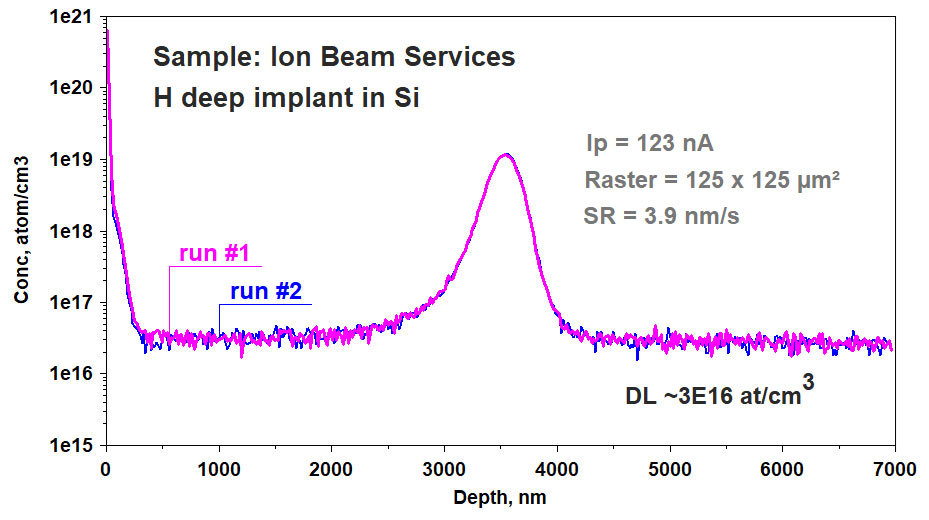
Figure 1: Hydrogen SIMS depth profiles obtained in a deep 1H implant in silicon (Rp ~3.7 μm and maximum concentration ~1E19 at/cm3). Two runs are overlaid. Analysis time: 30 min per run. Data collected on the IMS 7f-Auto. Sample courtesy of Ion Beam Services.
Hydrogen in Advanced Materials: Beyond Semiconductors
Zirconium Alloys for Nuclear Applications
Zirconium alloys used in fuel cladding are particularly sensitive to hydrogen and oxygen uptake. SIMS mapping reveals diffusion patterns, oxide layer behavior, and segregation features with micrometer scale lateral resolution, insights that are essential for understanding hydrogen embrittlement and corrosion processes.
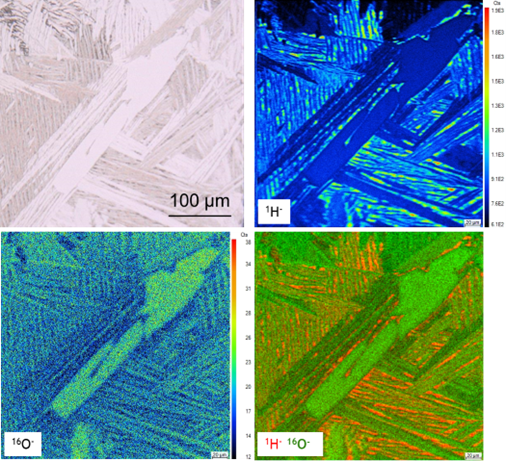
Figure 2: SIMS scanning ion images (H-, O- and a red-green H- & O- overlay), along with a digital microscope image (top left), acquired on a zirconium sample. Large field of view: 300 × 300 µm2. Lateral resolution: ~1µm. Data collected on the IMS 7f-Auto. Sample courtesy of Séverine Guilbert and David Suhard, ASNR (France).
A Complete Solution for Modern Hydrogen Analysis
Dynamic SIMS continues to define the state of the art in hydrogen and light element characterization thanks to:
- exceptional sensitivity
- deep and rapid profiling
- advanced automation
- high resolution imaging
The IMS 7f-Auto provides robust, reproducible hydrogen analysis for semiconductor manufacturing, materials research, and other demanding applications. It offers a comprehensive platform for understanding hydrogen behavior in some of today’s most challenging scientific and industrial contexts.
For more information:
Application Note: Hydrogen depth profiling in semiconductor materials.
About the CAMECA IMS 7f-Auto
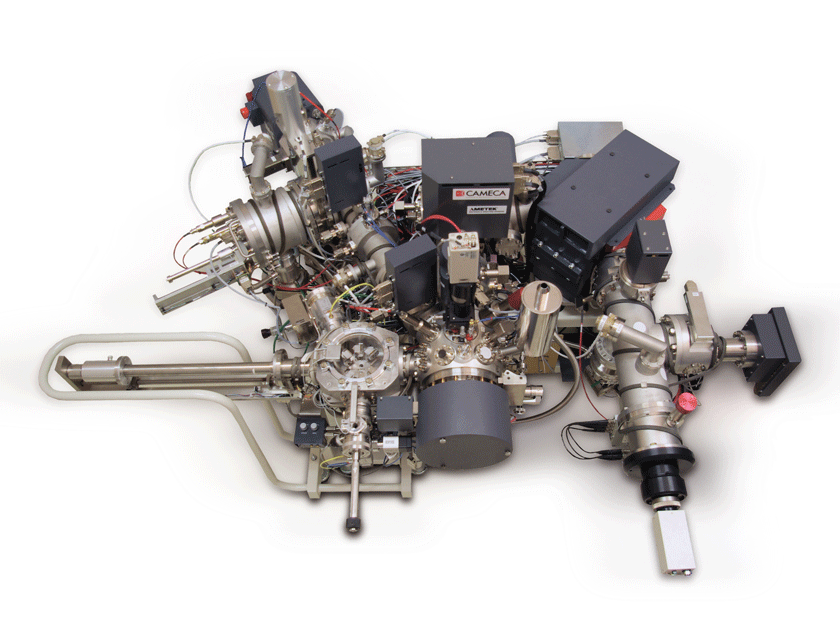
The CAMECA IMS 7f-Auto is the latest version of our successful IMS xf product line. Learn more about the SIMS technique and CAMECA's instruments by visiting CAMECA's SIMS Overview.
Authors: Paula PERES (Applications Manager), Jinlei REN (Applications Engineer), Seoyoun CHOI (Expert Applications Engineer)