Origins of Earth’s Hydrological Cycle
Water is essential for life on Earth, and understanding its origins is key to explaining how life began.
In their paper “
Onset of the Earth’s hydrological cycle four billion years ago or earlier” published in
Nature Geoscience, Hamed Gamaleldien and colleagues investigate when a true hydrological cycle (continuous exchanges of water between land, oceans, and atmosphere) first appeared.
Could this cycle have operated earlier than previously thought, during the Eoarchaean or even the Hadean (>4.0 Ga)?
To approach this question, the study focuses on variations of Oxygen isotopes, which are sensitive to rock–fluid interactions, preserved in zircon grains.
Zircons are exceptional geological archives because of their extreme resistance to alteration, allowing them to survive for billions of years and making them ideal to reconstruct Earth’s earliest environments.
Sample Collection and Selection
Small detrital zircon grains (< 0.5 mm) dating from the Hadean to Paleoarchean (≈ 4.4 - 3.2 Ga) were recovered from Mesoarchean (~ 3.1 Ga) metasedimentary rocks in the Jack Hills belt, Western Australia.
Two samples were collected:
- 21JH-A01 from a metaconglomerate at the W74 Discovery site (where the oldest known crystal on Earth, 4.404 ± 0.008 Ga, was identified),
- 21JH-B01 from a quartzite located about 350 m to the northeast.

Figure 1: Picture taken at sample collection site in Jack Hills belt, Western Australia
Over 2 500 zircon grains from each sample were mounted, polished, and examined using transmitted and reflected light microscopy combined with cathodoluminescence imaging to reveal internal structures and guide SIMS analytical spot placement.
Based on these observations, 671 grains from 21JH-A01 and 700 grains from 21JH-B01 showing magmatic textures were selected for subsequent U-Pb and oxygen isotope analyses by
Large Geometry Secondary Ion Mass Spectrometry (LG-SIMS).
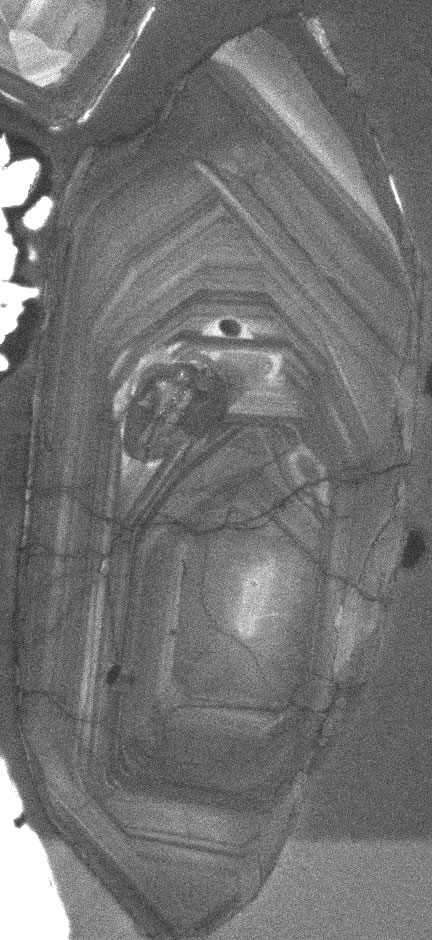
Figure 2: Cathodoluminescence image of a Jack Hill zircon grains revealing internal complex structure
SIMS Provides High Precision Isotopic Results
Initial U-Pb and Oxygen isotope analyses were performed using a CAMECA LG-SIMS (IMS 1280-HR model) at the Institute of Geology and Geophysics, Chinese Academy of Sciences (IGGCAS), Beijing.
A second analytical session on 25 additional zircon grains was also conducted with a CAMECA LG-SIMS, the latest generation IMS 1300-HR3 model, at the John de Laeter Centre, Curtin University, following similar procedures.
U-Pb dating of zircons from sample 21JH-A01 yielded ages from 4.209 ± 0.005 Ga to 3.143 ± 0.008 Ga, while grains from 21JH-B01 ranged from 4.279 ± 0.005 Ga to 1.854 ± 0.039 Ga, both showing a major peak near 3.4 Ga.
The ¹⁸O/¹⁶O isotopic ratios were measured within the same domains as the U-Pb spots, with δ¹⁸O values spanning from 2.6 ± 0.1‰ to 7.5 ± 0.1‰ for 21JH-A01 and from -0.1 ± 0.1‰ to 9.5 ± 0.1‰ for 21JH-B01.
Both samples exhibited a dominant peak around 6.0 ‰ near the upper mantle range.
To assess potential secondary alteration, ¹⁶O¹H/¹⁶O ratios were measured, revealing low hydration levels (Δ¹⁶O¹H/¹⁶O < 10%) compared to crystalline reference zircons, thereby confirming that the Jack Hills grains preserve primary magmatic oxygen isotope signatures.
 |
The SIMS technique was essential for this research. The ability of the LG-SIMS instruments to obtain high-precision oxygen isotopic data from tiny zircon domains allowed us to uncover the earliest evidence of Earth’s hydrological cycle. The fine-tuned instrument performance and reliable data acquisition made it possible to tackle questions that were previously beyond reach.
Hamed Gamaleldien, Assistant Professor at Khalifa University, Abu Dhabi Emirate, United Arab Emirates.
|

|
Geological Significance of Oxygen Isotope Variability
Oxygen isotope data reveal that most Jack Hills zircon grains have δ¹⁸O values above mantle composition, with a moving average slightly exceeding the mantle range.
However, the 5% quantile shows 2 two distinct excursions to sub-mantle values between 4.13 - 3.90 Ga and 3.48 - 3.35 Ga, while other apparent anomalies at ~ 3.05 Ga and 3.8 - 4.2 Ga are likely due to isolated data points.
Among the sub-mantle analyses, 84 % fall within 2.8 - 4.7 ‰, but a small fraction (16 %) records extremely low values, from 2.0 ‰ at ~ 4.0 Ga to -0.1 ‰ at ~ 3.4 Ga.
Overall, Jack Hills zircons display highly heterogeneous compositions: 67 % above mantle (> 5.9 ‰), 28 % within mantle range (4.7 - 5.9 ‰), and 5 % below (< 4.7 ‰).
Supra-mantle values indicate magmas that assimilated supracrustal material interacting with near-surface water at low temperatures, whereas sub-mantle signatures require high-temperature hydrothermal exchange (> 300 °C) between magmatic protoliths and surface-derived water.
The presence of isotopically light Hadean zircons supports prolonged interaction between emergent proto-crust and water over tens to hundreds of millions of years, consistent with partial melting of hydrothermally altered shallow mafic rocks.
This long-term process explains the progressive decrease in δ¹⁸O from 4.2 ‰ at ~ 4.10 Ga to 2.1 ‰ by 4.02 Ga, and down to -0.1 ‰ at ~ 3.4 Ga, suggesting that these ages represent minimum estimates for crustal hydration.
The observed diversity in δ¹⁸O likely reflects repeated remelting and assimilation of hydrated proto-crust under varying thermal conditions.
Modeling Early Water-Rock Interactions
Hydrous alteration was likely widespread on Earth as early as 4.4 Ga, though whether the water was saline, meteoric, or a mix remains uncertain.
To explain the extremely low δ¹⁸O observed in Jack Hills zircons, Monte Carlo simulations were performed using mixtures of mantle-derived magma, continental crust, and seawater or meteoric water, based on accepted isotopic ranges for the present day and the Archaean.
The models show that seawater alone cannot produce δ¹⁸O values below 3 ‰; meteoric water is required to achieve the light signatures recorded in these zircons, although seawater-rock interaction dominated overall.
Combined seawater-meteoric water ratios, constrained by estimates of continental crust abundance in the Hadean, successfully reproduced the observed isotopic patterns, including the peak near 6.0 ‰ and both sub- and supra- mantle arrays.
These findings indicate that shallow magmatic-hydrothermal systems involving meteoric water existed by ~ 4.0 Ga, marking the earliest emergence of continental crust, freshwater reservoirs, and the start of Earth’s hydrological cycle.
This early cycle likely created environments favorable for life, as suggested by stromatolites at ~ 3.48 Ga and isotopic evidence of increasing oxygenation.
Low δ¹⁸O excursions at 4.0 - 3.9 Ga imply that essential conditions for life may have been met even in the Hadean, though direct evidence remains elusive due to Earth’s dynamic geology.
Drop by drop, Earth’s water story becomes clearer!
References:
[1] Gamaleldien et al., Onset of the Earth’s hydrological cycle four billion years ago or earlier, Nature Geoscience (2024), DOI: 10.1038/s41561-024-01450-0
[2] Valley, J. W. et al. 4.4 billion years of crustal maturation: oxygen isotope ratios of magmatic zircon. Contrib. Mineral. Petrol. 150, 561–580 (2005), DOI: 10.1007/s00410-005-0025-8
[3] Eiler, J. M. Oxygen isotope variations of basaltic lavas and upper mantle rocks. Rev. Mineral. Geochem. 43, 319–364 (2001), DOI: 10.2138/gsrmg.43.1.319
[4] Troch, J., Ellis, B. S., Harris, C., Bachmann, O. & Bindeman, I. N. Low-δ18O silicic magmas on Earth: a review. Earth Sci. Rev. 208, 103299 (2020), DOI: 10.1016/j.earscirev.2020.103299
About the CAMECA IMS 1300-HR³

The IMS 1300HR3 is the successor to the CAMECA IMS 1280. Learn more about the SIMS technique and CAMECA's instruments by visiting CAMECA's SIMS Overview.
Authors: Paula PERES, Flore BARBIER
Special thanks to Laura Créon for her early contribution and the ideas that guided the development of this blog.