Light-emitting diodes (LEDs) have revolutionized lighting and display technologies, but their performance still hinges on the precise control of nanoscale material properties. One of the most powerful tools for probing these properties is
Atom Probe Tomography (APT) , because it offers 3D atomic-scale chemical imaging with sub-nanometer resolution. While III-V materials such as GaN based devices have long been a classic application of APT, both automated approaches in
LEAP 6000 XR and wide field of view capabilities in the
Invizo 6000 have opened new frontiers in understanding and optimizing LED materials.
Understanding V-defects in GaN-based LEDs
One of the persistent challenges in GaN-based LEDs is the presence of V-defects—inverted pyramidal voids that form during epitaxial growth. These defects can disrupt carrier transport and act as carrier recombination sites. The LEAP, Invizo, and
EIKOS-UV are all fully capable of analyzing III-V structures, but there are particular advantages in the latest generation of instruments worth highlighting here.
Wide field-of-view APT: revealing structural impacts of V-defects
In some cases, APT analyses are limited by their small field of view, typically tens of nanometers across. While this is sufficient for studying dopant distributions and interface roughness, it can miss the larger structural context needed to fully understand extended features like V-defects when they impact a variety of other structures. Fortunately, the wider field of view offered with an Invizo can provide a huge advantage in these cases
[1] Each structure in an LED serves a purpose, and understanding the extent to which a defect impinges on these structures can provide key insights into the impacts of a defect into device performance.
Quantifying Quantum Well variations with Invizo 6000
Figure 1, shows a complete V-defect of a sample analyzed with the Invizo 6000. Note that the V-defect causes variation in the thickness of the electron blocking layer and Quantum Well structures highlighted by the aluminum and indium distributions respectively. This V-defect extends approximately 100 nm from the p-GaN layer through to the In-rich quantum wells in the reconstructed data. A V-defect may either enhance or degrade device performance; on one hand, it can make transport of holes easier through the thinner Al-rich electron blocking layer (EBL), on the other hand, disruptions in the quantum well structure may make it easier for electrons and holes to combine without emitting light. Additionally, we can see that there are significant variations in thickness of the In-rich quantum well structures, which can be responsible for reducing light emission. The wide field of view capability in the Invizo makes it possible to not only measure the extent of this large v-defect range but also quantify the impact on surrounding structures like the quantum wells and measure chemical roughness over a much larger area than previously possible.
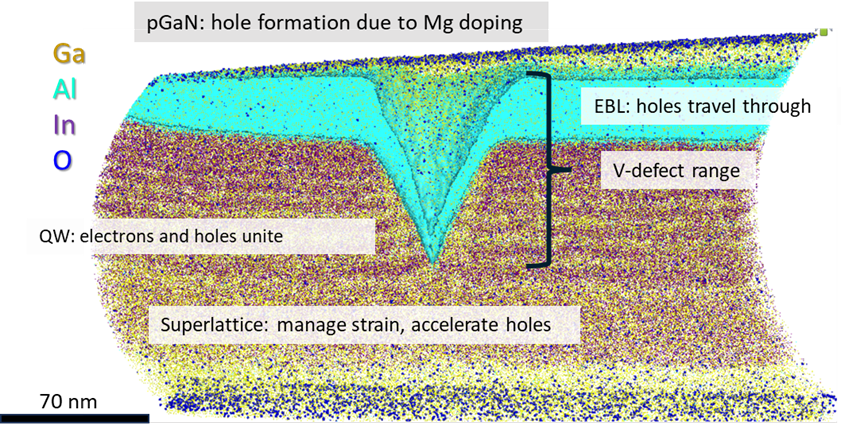 Figure 1: INVIZO 6000 dataset of a deprocessed LED device.
Automated scripted data acquisition: accelerating LED innovation through advanced APT techniques
The second way that newer technology can help us is determining optimal acquisition parameters. One classic phenomenon for III-V materials is the sensitivity of neutral formation to acquisition conditions, which often appears as a nitrogen deficiency in the analyzed data
[2]. Many times, this causes skepticism in interpreting results, particularly for those with less experience. However, tuning acquisition conditions to reach this stoichiometry while understanding the impacts of reduced laser energy on background noise is a complex, iterative process. Enter Scripted Acquisition—a transformative automated approach that streamlines this challenge. The automation functions are available for LEAP systems and Invizo that can make it possible to scan through multiple acquisition conditions automatically and log the results
[3]. This makes it seamless to find the laser pulse energies that lead to 50:50 Ga:N stoichiometry, and/or provide thresholds for background conditions that lead to high quality APT results.
Figure 2a, shows the Script Browser module that enables “properties”, or values that can be changed throughout the acquisition, to be applied. In this example, the laser pulse energy was changed and the composition of GaN was logged for 1 million ion intervals. This allows for the parameter space to be mapped, and concentration data as well as metadata such as temperature, background, etc to be logged and analyzed without reconstruction. Figure 2b, shows the results of this laser pulse energy design of experiments for GaN, allowing the analyst to balance acquisition conditions targeted for composition or background reduction that would be time consuming and potentially less accurate if done without automation.
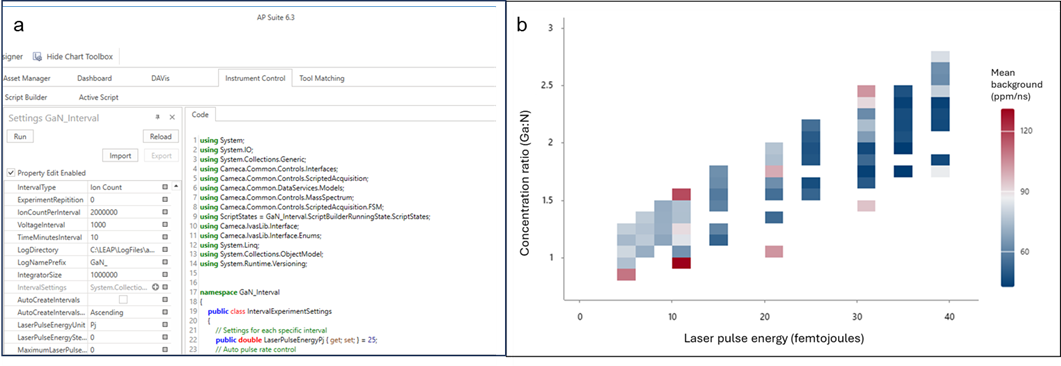 Figure 2: LEAP acquisition script showing changeable properties, results of a scripted acquisition experiment logging Ga:N ratio vs. laser pulse energy and background of those intervals on a LEAP 5000XR.
Ultimately, this leads to faster development cycles and enables data-driven decision making—paving the way for more efficient devices and scalable manufacturing.
Conclusion: APT’s role in the future of optolectronic materials
APT is transforming the way we understand LED materials at the atomic level. From detecting Mg dopant clustering to mapping chemical roughness and validating stoichiometry, this technique offers unparalleled insights that are driving innovation in optoelectronics. As instrumentation continues to evolve, APT will remain a cornerstone of nanoscale materials research, illuminating the path toward more efficient and reliable LEDs.
References:
[1] Tegg, L. et al. Characterising the performance of an ultrawide field-of-view 3D atom probe. Ultramicroscopy 253, 113826 (2023).
[2] Morris, R. J. H. et al. Toward accurate composition analysis of GaN and AlGaN using atom probe tomography. J. Vac. Sci. Technol. B 36, 03F130 (2018).
[3] Reinhard, D. et al. Increased LEAP Utilization Through Automation of Multi-specimen Alignment and Acquisition. Microscopy and Microanalysis 26, 2616–2616 (2020).
Authors: Katherine RICE, Lazar VUCICEVIC