Why Understanding Early Tectonic Environments Matters
Early tectonic environments often remain obscure due to the formation and recycling of continental crust more than 4 billion years ago, making it difficult to understand Earth's geodynamic, surface, and atmospheric conditions during the early Archean.
Interpreting processes between zircon and whole-rock geochemistry in various tectonic settings can provide clues of the tectonic provenance, particularly when zircon represents the only reliable record from that period.
Zircon Evidence of Early Earth’s Climate and Crustal Reworking
Zircons indicate that surface conditions were relatively cool and humid during the Hadean, and that low temperature formed materials were incorporated into crustal magmas before 4.03 Ga. However, the tectonic setting responsible for primitive crust reworking throughout the Archean remains questionable.
In this study, Mixon et al. analyzed magmatic zircons from two of Earth’s oldest zircon-bearing crusts (3.9 - 2.8 Ga): the Acasta Gneiss Complex (AGC) and the Saglek-Hebron Complex (SHC) in Canada.
Based on well-known oxygen geochemistry in zircons and trace element ratios able to reflect the melt composition at the crystallization time (usually used to distinguish between mid-ocean ridge-type, ocean island-type, and arc-type zircons), the research team evaluated magmatic zircons, crystallized from the same host rock, to establish some correlations between isotopic analyses and whole-rock chemistry.
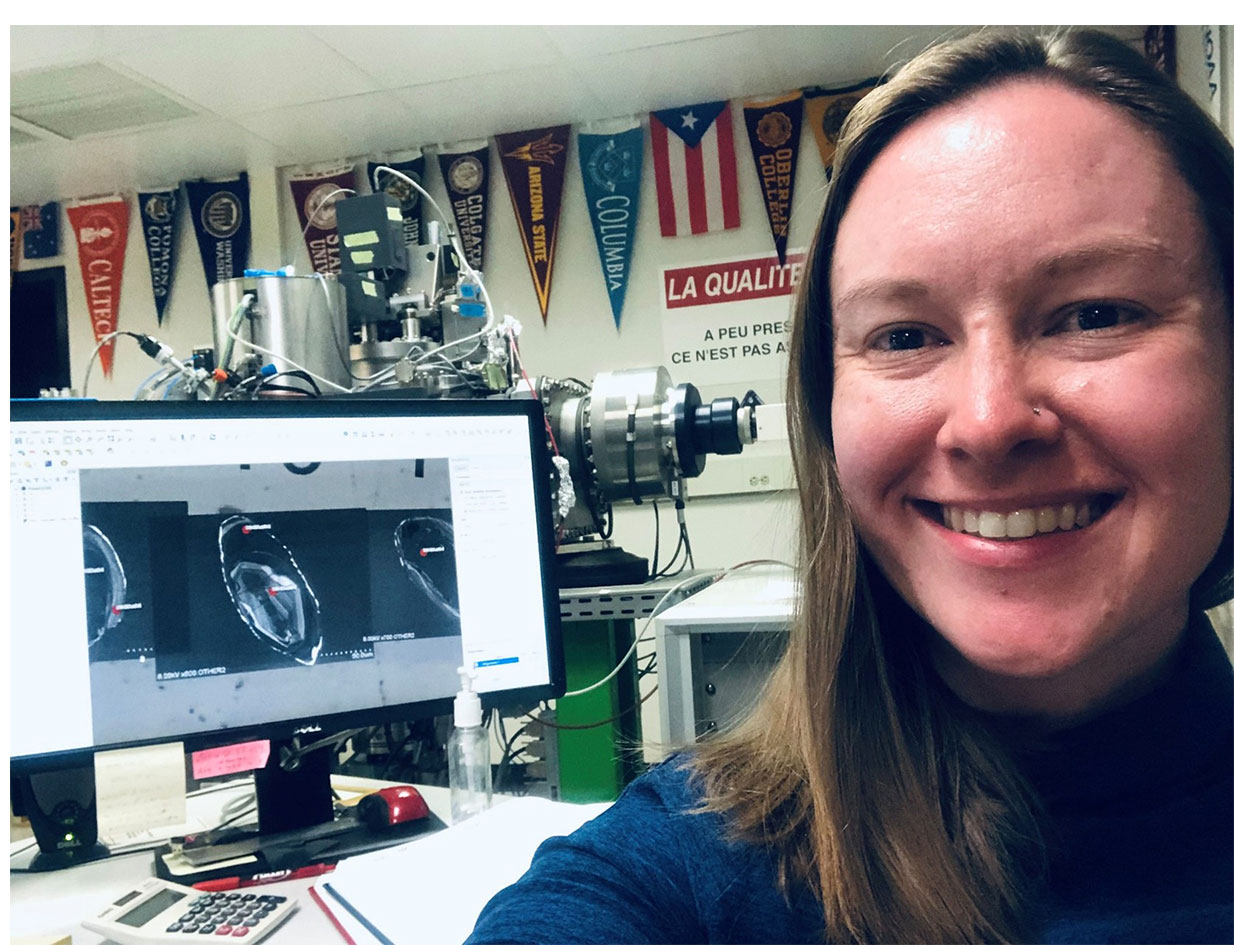
 Plate tectonics, or how the continents move around and interact with each other, makes our planet uniquely dynamic, on a solar system scale. It has been hypothesized that because plate tectonics is important for moving carbon and water around on long time scales, it might be important for how life evolved on Earth. Therefore, understanding how tectonics worked early in Earth history is key for identifying when and how we got the styles of modern tectonics we see today, and how these styles might be expected to look early in planetary development for other possibly habitable planets.
Emily E. Mixon, Isotope Geochemist et Lab manager at University of Wisconsin-Madison, USA.
Debating Early Earth’s Crust Formation Mechanisms
The Early Archean (about 3.9 billion years ago) has been a poorly understood period. Traditional plate tectonic models struggle to explain the diversity of rocks and geochemical signatures of this era.
The following question has remained for a long time: “ Was the formation of the early Earth’s crust driven by stagnant-lid tectonics (such as oceanic plateaus) or by mobile-lid processes (like modern subduction zones)? ”.
Trace element compositions, including ratios of uranium, niobium, scandium and ytterbium, could serve as indicators. However, they require careful screening to ensure that zircons have retained their original geochemistry.
LG-SIMS: delivering unparalleled analytical capabilities for in-depth geochemical investigations
A comprehensive and in-depth study was conducted based on
Large Geometry Secondary Ion Mass Spectrometry (LG-SIMS), using the CAMECA -IMS 1280 at the WiscSIMS Laboratory (University of Wisconsin-Madison).
Different types of analyses were performed in zircon samples from 15 granitoid rocks from the Acasta Gneissic Complex (AGC) and Saglek-Hebron Complex (SHC): in situ oxygen isotope, trace-element, and U-Pb age analysis.
LG-SIMS oxygen isotope data were first used to decipher which zircon grains are true Early Archean evidence.
- In all, 323 oxygen isotope analyses were done on 197 zircons from AGC (crystallization ages ranging from 3.95 to 3.36 Ga). Of these, 201 analyses passed the screening criteria and gave δ18O values that range from +5.2‰ to +7.0‰).
- Among 271 oxygen isotope analyses done on SHC zircons (crystallization ages from 3.87 to 2.79 Ga), 208 met the screening criteria and had δ18O values ranging from +5.0‰ to +8.4‰.
Moreover, 26 major and trace elements (including Al, P, Ca, Sc, Ti, Fe, Y, Nb, REE, Ta, Th and U) were measured on 145 AGC zircon domains and 135 SHC ones, identified as preserving primary zircon δ
18O.
The LG-SIMS mass spectrometer was tuned to achieve a high mass resolving power of M/ΔM ≈ 12,500, sufficient to resolve main mass interferences for analyzed species.
Geologists were able to recognize some rare earth element patterns, such as depletion in light REEs and enrichment in heavy REEs, further indicative of primary geochemistry (Fig.1).
- U/Nb ratios ranging from 26 to 76 for SHC, and 29 to 195 for AGC.
- Sc/Yb ratios were between 0.15 and 2.65 for SHC, and between 0.17 and 0.53 for AGC.
These high ratios for U/Nb (>20) and Sc/Yb (>0.1) are compatible with hydrated melting processes, (confirming primary magmatic origins of selected zircons).
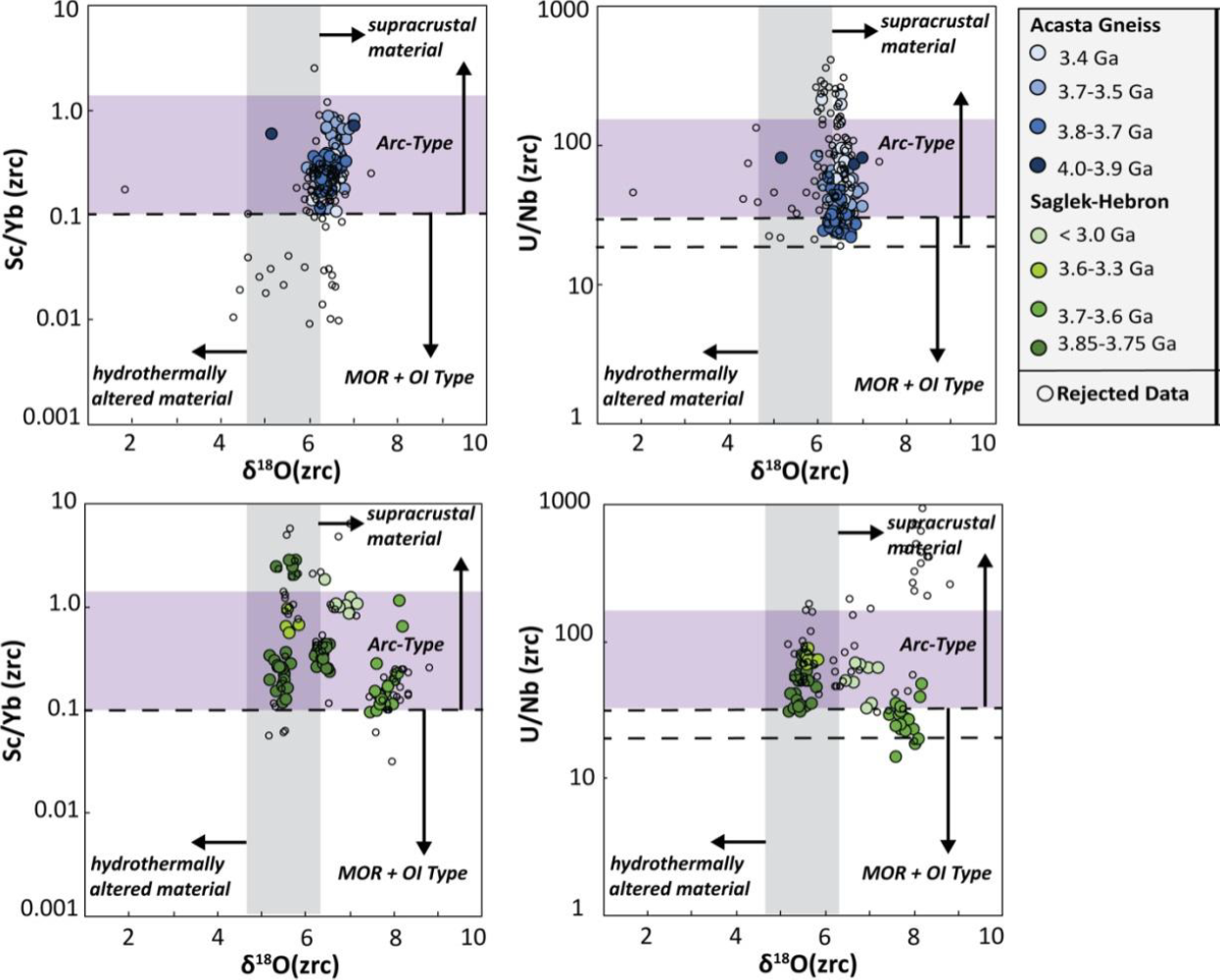
Figure 1: Cross plots of O isotopes and zircon trace element ratios for AGC (blue) and SHC (green), shown for each individual zircon analysis, with symbols shaded by magmatic generation.
Then, the δ
18O and trace element data of zircons meeting the selection criteria were compared with the crystallization ages of their host rocks.
U-Pb analyses on AGC grain domains were performed by SIMS: 198 of 227 analyses showed a concordance between 95% and 105%.
Gathering in situ zircon analyses and whole-rock data, Mixon et al. observed unexpected results (Fig.2):
- AGC zircons were initially dominated by intraplate tholeiitic magmatism, then transitioning to arc-type hydrous magmatism around 3.6 Ga.
- SHC zircons show evidence of hydrous melting at depths as early as 3.9 Ga, with varying melt depths and sources over time.

Figure 2: Time series of zircon isotope and trace element data: (A) Zircon εHf, (B) Zircon δ18O, (C) Zircon U/Nb,(D) Zircon Sc/Yb.
These results challenge the idea of a singular tectonic style during the early Earth. They support a model of tectonic diversity, with subductions and crustal reworking parallel to lid stagnation processes, and the simultaneous operation of stagnant and mobile lid regimes.
Thus, the research team suggested that the melting of hydrous basalt was not limited to a single tectonomagmatic process during the Archean, but also occurred during the reworking of the Hadean protocrust and the formation of juvenile crusts within two cratons, as early as 3.9 Ga.
Rethinking Early Earth Dynamics
Thanks to their in-depth study, Mixon et al. have demonstrated that in situ zircon geochemistry analysis (oxygen isotope, trace-element and U-Pb), combined with whole-rock data, can reveal the complex tectonic landscape of the early Earth.
Their paper refines our understanding of early Earth dynamics by proving that hydrous melting processes were widespread and occurred in multiple tectonic settings, contributing to the formation of continental crust as early as 3.9 Ga.
Let us hope that, in the future, more geologists will have fun combining in situ zircon geochemistry as a time exploration tool with the chemistry of multiple mineral and rock-scale systems, to find out reliable interpretations of Early Archean history.
References:
C. Grimes, J. Wooden, M. Cheadle, B. John, “Fingerprinting” tectono-magmatic provenance using trace elements in igneous zircon. Contrib. Mineral. Petrol. 170, 1–26 (2015).
N. Drabon et al., Heterogeneous Hadean crust with ambient mantle affinity recorded in detrital zircons of the Green Sandstone Bed, South Africa. Proc. Natl. Acad. Sci. U.S.A. 118, e2004370118 (2021).
J.-F. Moyen, H. Martin, Forty years of TTG research. Lithos 148, 312–336 (2012).
About the CAMECA IMS 1300-HR³
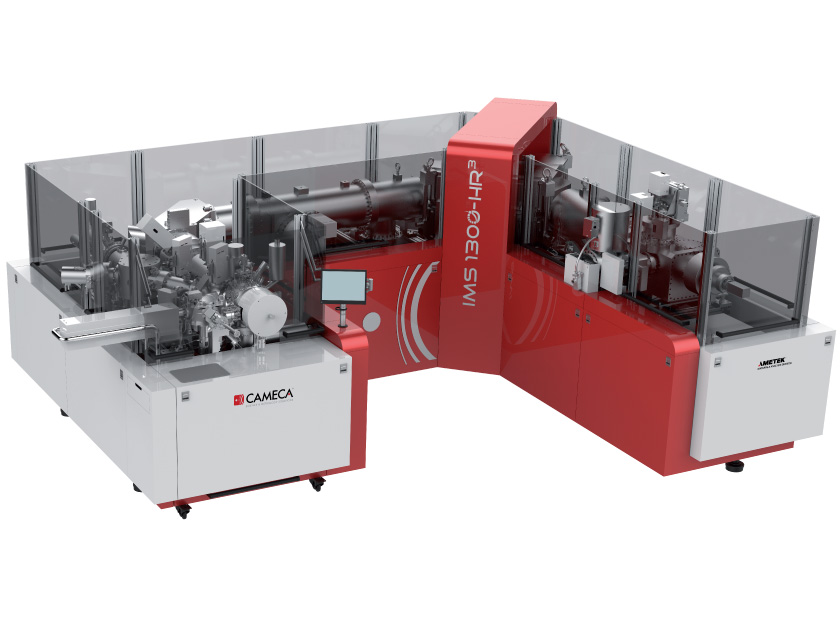
The
IMS 1300HR3 is the successor to the CAMECA IMS 1280. Learn more about the SIMS technique and CAMECA's instruments by visiting
CAMECA's SIMS Overview.
Authors: Paula PERES, Flore BARBIER
Special thanks to Laura Créon for her early contribution and the ideas that guided the development of this blog.