In today's fast-paced scientific landscape, data organization stands as a formidable challenge. This is especially true when multiple users are involved, each contributing to and drawing from a shared pool of data. This complexity is compounded by the fluid nature of scientific teams. Researchers and technicians often join and leave projects, each bringing their own organizational methods and leaving behind a trail of data that must be seamlessly integrated into the existing framework.
Moreover, the arrival of new sample projects that relate to or build upon previous work presents another layer of difficulty. Ensuring that these new samples are appropriately linked to historical data is crucial for maintaining the continuity and integrity of research. Without a robust system in place, valuable insights can be lost, and the efficiency of the research can be severely hampered.
Designed to streamline and simplify the management of such intricate data collections, this is where CAMECA's integrated database for
Atom Probe Tomography research projects steps in.
Bridging the gap between APT data acquisition and analysis
CAMECA has long integrated an experiment database into the data acquisition workflow of its
atom probe instruments. This approach ensures that data organization is not an afterthought but a fundamental component of the experimental process.
Before an experiment can be conducted, the specimen must be created within the database. Once the acquisition starts, the database assigns a unique experiment ID to the raw data file. This ID acts as a digital fingerprint, ensuring that each data set is uniquely identifiable and traceable throughout its lifecycle.
In this system, specimens are not isolated entities but parts of larger projects. These projects, in turn, are organized under broader categories. At each level, relevant information is stored to provideimportant context about the sample and the project goals. This hierarchical structure allows for a more organized and intuitive data management system, where researchers can easily locate and access the data they need.
Introducing the Data Navigator
Traditionally, CAMECA’s APT software system had a significant limitation: while it excelled at managing data acquisition, it had no awareness of the reconstructions and analyses conducted post-acquisition. This gap meant that while the raw data was meticulously cataloged, the subsequent steps of data interpretation and analysis were often disjointed and less organized. To solve this, the
AP Suite software package introduced the Data Navigator module. It provides a new graphical user interface for the integrated database which covers the entire life cycle of the sample project data, bridging the gap between atom probe data acquisition and analysis. It offers a user-friendly platform for researchers to interact with their data, ensuring that every stage of the data lifecycle is captured and organized within a single, cohesive system.
Benefits of the Data Navigator
- Enhanced Traceability: Every piece of data is linked back to its origin, providing a clear and traceable path from specimen creation to final analysis.
- Improved Collaboration: Multiple users can access and contribute to the database, ensuring that all team members are working with the most up-to-date information.
- Data Integrity: The integrated database ensures that data is consistently organized and maintained, reducing the risk of errors and mismanagement.
- Streamlined Workflow: By integrating data acquisition and analysis, the Data Navigator simplifies the workflow, allowing researchers to focus more on their experiments and less on data management.
- Scalability: The system is designed to handle large volumes of data, making it suitable for extensive and long-term research projects.
Data Navigator Layout
The Data Navigator is laid out with a convenient left-to-right workflow that guides the user through a series of view tabs that progress from a top-level overview to detailed information about a specific reconstruction.
The first tab, called Projects, contains the organizational categories on the left, the sample projects in the center, and project details on the right. When a category is selected, the project list automatically sorts to show only projects associated with the selected category. Likewise, when a project is selected, the details panel updates with the information for that project.
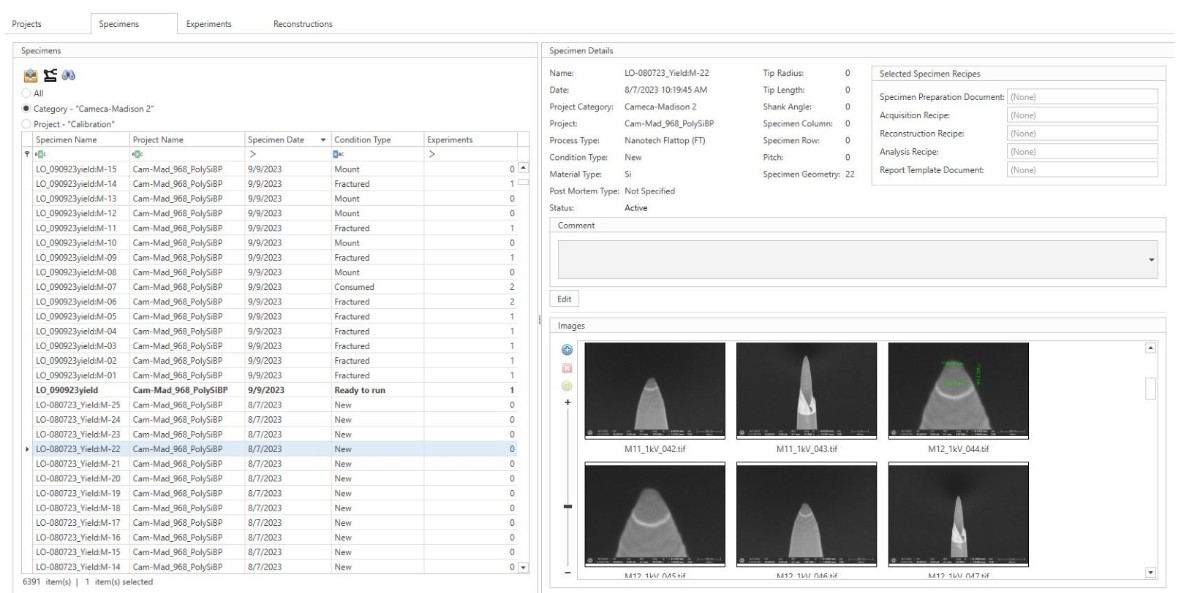
The Specimens tab is the second view tab of the Data Navigator. Automatically sorted to show the specimens for the selected project, details and specimen images for the selected specimen are shown on the right.
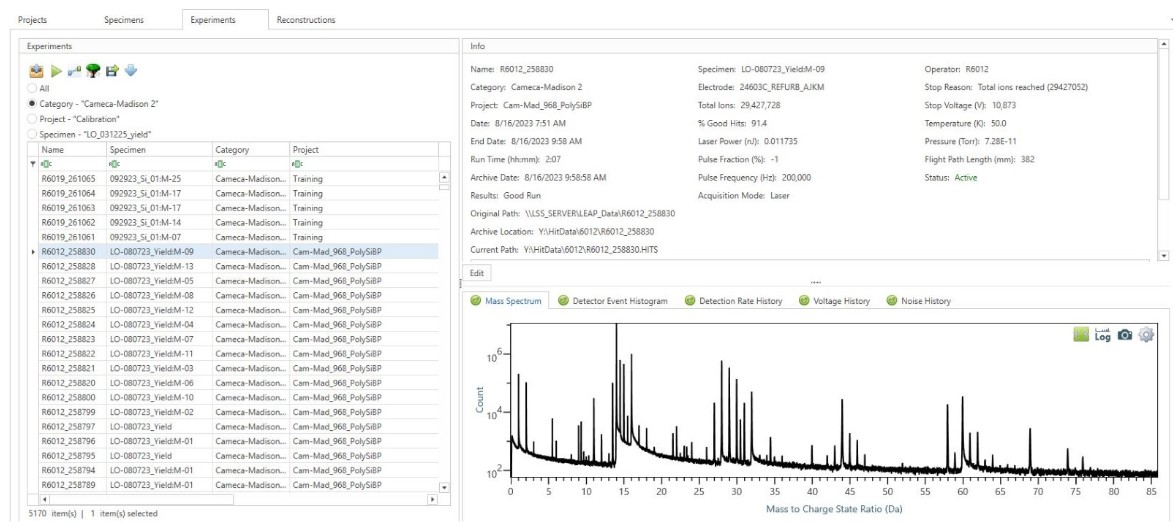
The third view tab shows the Experiments acquired for the selected specimen. In additional to the variety of information available in the table and details panel, useful charts like the mass spectrum, detector event histogram, and voltage history are displayed for the selected experiment.
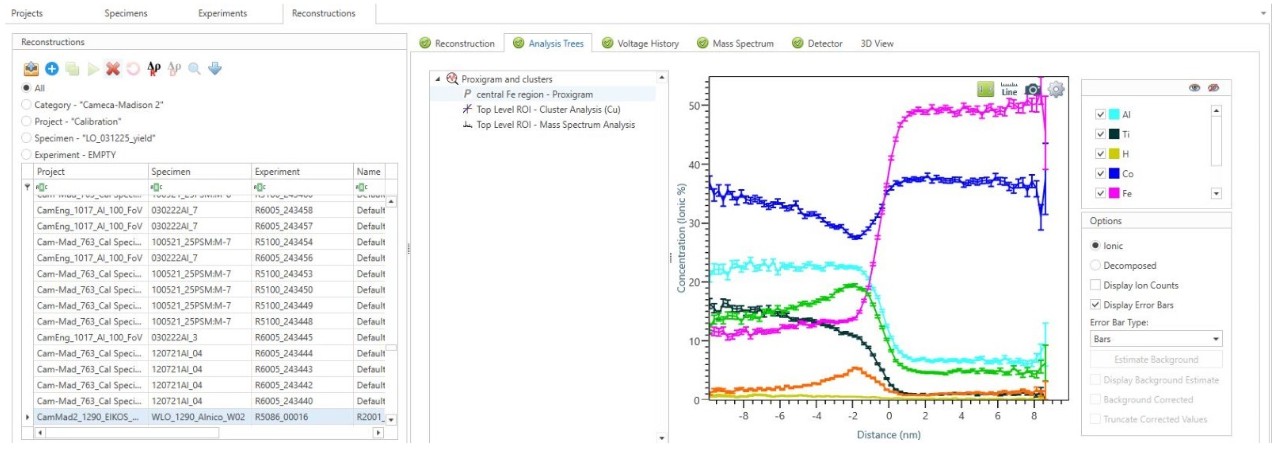
The final tab shows the reconstructions for the selected experiment. It not only shows data from the reconstruction of the selected dataset, but also provides convenient access to pinned analyses within a saved analysis state.
In each tab, the tables can be quickly reverted to unsorted views and the database can be searched by quick filters or advanced multi-level filters to find a particular dataset of interest.
Enhancing Scientific Research with Robust Data Management Solutions
In conclusion, data organization in a multi-user environment is a complex but critical task that can significantly impact the success of scientific research. CAMECA's integrated database and the Data Navigator module provide innovative solutions to these challenges, ensuring that data is meticulously organized, traceable, and easily accessible. By bridging the gap between data acquisition and analysis, these tools empower researchers to achieve more insightful and impactful results. As scientific teams continue to evolve and grow, the importance of robust data management systems will only increase, making tools like the Data Navigator indispensable in the pursuit of knowledge and discovery.
To get familiar with Atom Probe Tomography in less than 3 minutes, watch our whiteboard animation: https://www.youtube.com/watch?v=CXiDO4vjfVg
Author: David Reinhard (Senior Product Manager & Application Engineering)