One of the most important reasons for exploring the Solar System comes from the quest of our origins and the human need to understand where we come from and how the World formed. In its 4.5 Ga of existence, the Earth has evolved a lot, erasing most of the traces of its origins. Therefore, to understand the early years of the Solar System, we must find more primitive sources, which have retained the marks of the conditions of formation of the solar system. In the past, the main source of this primitive extraterrestrial material were meteorites, which are asteroidal or planetary debris fallen on Earth. But since the Apollo missions, and more recently the development of Sample Return missions, it is possible to collect samples from specific extraterrestrial bodies in the solar system.
The advantage of those sample return missions is that, instead of leaving scientists at the mercy of the randomness of rocks falling to Earth, they target specific and carefully chosen bodies, in the hope to answer a number of specific scientific questions. This is why the Hayabusa, and later the Hayabusa2 missions, launched by JAXA (Japanese Space Exploration Agency) targeted specific asteroids from the asteroid belt. Hayabusa visited asteroid Itokawa in 2005, while Hayabusa2 visited asteroid Ryugu in 2018-2019.
Launched in 2014, space probe Hayabusa2 reached asteroid Ryugu in 2018 and collected asteroidal material the following year before returning to Earth at the end of 2020. Ryugu is a C-type asteroid, meaning that it is rich in organic matter. Comparison between asteroid spectral data collected through telescopes, and meteorites in our collections analyzed in laboratories has led scientists to believe that C-type asteroids were linked to Carbonaceous Chondrites (CC) meteorites, and asteroid Ryugu linked to the CC sub-group CM (Murchison-like CC), which are particularly interesting to scientists for what they can tell about the early years of the solar system.
The unique advantages of SIMS for analyzing precious extraterrestrial samples
Extraterrestrial samples brought back by Sample Return Missions are precious because they give us a unique insight into the origin of the Solar System and the conditions of formation and mechanisms that shaped the Solar System. Protected from terrestrial contamination, they are more pristine than meteoritical samples, which have sustained surface heating during their fall through the atmosphere, and, for some, weathering and contamination during their stay on Earth. But those pristine samples are often limited in size and complex. Bulk analyses would both consume too much material and mix different signatures, thus losing precious information. In situ analyses using as little material as possible is therefore crucial, making SIMS the most relevant analytical tool.
In addition, the SIMS technique is particularly suitable for isotopic analyses, which are of particular interest in the Cosmochemistry field of Science. Most elements of the periodic table have different isotopes. Chemical and physical reactions cause isotopic fractionations, resulting in large ranges of isotopic ratios as records of those reactions undergone by a mineral, and by extension, by the body it belonged to at the time. Therefore, isotopic signatures are commonly used to reconstruct formation conditions (oxidation-reduction, temperature, pressure, etc…) or events undergone by the studied bodies in the solar system.
SIMS instruments have been developed to measure isotopic ratios at the micron and sub-micron scale, with optimized precision. Several laboratories have used CAMECA SIMS instruments (LG-SIMS and NanoSIMS) on Ryugu material brought back by the Hayabusa2 mission.
What we learned from SIMS analyses of asteroid Ryugu
- Connecting the dots with meteorites
Hydrogen and Nitrogen isotopic studies of Ryugu organic matter at sub-micron scale [1] confirm the link between C-type asteroids and primitive CC, in particular CM (Murchison-like Carbonaceous Chondrites) and CI (Ivuna-like Carbonaceous Chondrites) sub-groups, though other studies seem to link C-type asteroids to sub-type CI rather than CM.
Piani et al. [2] measured the D/H isotopic ratio (2H over 1H ratio of hydrogen isotopes) in various hydrous minerals of Ryugu using an LG-SIMS and measured an average δDRyugu = +59 ± 121 ‰ (2σ). This value is in good agreement with data previously reported in CI meteorites and would therefore put Ryugu closer to CI carbonaceous chondrite meteorites.
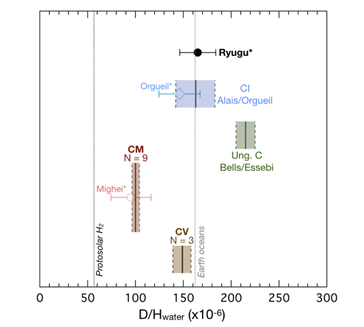 D/H isotopic ratio measured in asteroid Ryugu’s hydrous minerals [2] compared to Carbonaceous Chondrite meteorites of similar composition. Ryugu’s D/H signature indicates a close correlation to the CI sub-type of CC meteorites.
Mineralogical and elemental studies as well as its Cr-Ti and O isotope compositions measured with a NanoSIMS [3] have also shown that Ruygu is closely related to the CI chondrites. The presence of a large variety of hydrous minerals and the rarity of anhydrous minerals demonstrate the extensive aqueous alteration sustained by Ryugu. However, Oxygen isotope thermometry between magnetite and dolomite grains [3] have shown that it did not undergo any thermal metamorphism, and in that regard, Ryugu is the least affected by thermal processes of all carbonaceous chondrite type of material. This pristineness makes it a reference material of choice for the CI group. They thus suggest that Ryugu and CI’s water was derived from a D-enriched interstellar water that underwent re-equilibration during the evolution of the disk in the early years of the solar system.
- Unveiling Ryugu chronology
Ryugu’s parent body initially accreted mainly anhydrous dust and ice. Physical modelling of the evolution of planetesimals in the early solar system, combined with Oxygen isotopes thermometry suggest that this parent body accreted 2-4 Ma after the birth of the solar system. Then 1-2 My later, it sustained extensive aqueous alteration, resulting in the precipitation of many hydrated minerals such as dolomite, magnetite and phyllosilicates. Later, this parent body was disrupted, and the rubble pile asteroid that is Ryugu formed, losing most of its interlayer water. Aleon et al. (2024) [4] studied the Hydrogen content and isotopic composition of magnetite minerals from asteroid Ryugu with a NanoSIMS and have shown that the composition of the magnetite is inherited from the solar system local environment at the time of its formation. Formed in the outer parts of the solar system, beyond the snowline, Ryugu is therefore a precious material to better understand the origin of water in the outer solar system as well as aqueous alteration on asteroids.


LG-SIMS and NanoSIMS analysis spots on Ryugu’s minerals as observed afterward via Scanning Electron Microscope (SEM) [4]
Shedding light on the origin of Earth
The Earth formed 4.5 Ga ago, from the accretion of a variety of small planetesimal bodies. It is the assembly of all those bodies that gave the Earth its initial composition, from which it has evolved to what it is today: a water-rich planet. Scientists have long tried to reconstruct the distribution of the initial building blocks that made the Earth, and one of their main obsessions has been the origin of water – this component so fundamental to the birth of life on Earth. Did this water come from comets? Was it brought to Earth by asteroid-derived meteorites?
The newly redefined isotopic composition of CI water, based on the water composition measured on Ryugu allowed to reevaluate the mass contribution of CI-like material to Earth’s surficial reservoir [2]. Their mass balance calculation showed that CI water contributed to about 3% of Earth’s surface water.
Looking ahead, the continued advancement of SIMS technology and future sample return missions promise to further expand our understanding of the Solar System, which paradoxally brings us closer to understanding our origins.
References
[1] Yabuta et al., Macromolecular organic matter in samples of the asteroid (162173) Ryugu. Science (2023) DOI: 10.1126/science.abn9057
[2] Piani et al., Hydrogen isotopic composition of hydrous minerals in asteroid Ryugu, The Astrophysical Journal Letters (2023) DOI: 10.3847/2041-8213/acc393
[3] Yokoyama et al., Water circulation in Ryugu asteroid affected the distribution of nucleosynthetic isotope anomalies in returned sample, Science Advances (2023), DOI: 10.1126/sciadv.adi7048
[4] Aléon et al., Hydrogen in magnetite from asteroid Ryugu, Meteoritics & Planetary Science (2024) DOI: 10.1111/maps.14139
Authors: Céline DEFOUILLOY (NanoSIMS Applications Engineer)
Other Contributor: Paula PERES (SIMS Applications Lab Manager)