We had the pleasure of attending the ECROFI 2025 conference (European Current Research on Fluid Inclusions) this past June in Turin, Italy. This event brings together an international community of researchers specializing in fluid inclusions, with applications ranging from climate change and geothermal energy to magmatism, ore deposits, sedimentary environments (oil & gas), and cutting-edge theoretical and experimental research.
During the conference, we presented recent analyses carried out by Celine Defouilloy and Marc Debliqui, applications engineers at CAMECA, using the new
NanoSIMS-HR instrument equipped with a cryostage accessory.
Our talk, presented by Laura Créon, now services manager at CAMECA and holding a PhD in fluid inclusion science, titled Single Fluid Inclusion Analysis: In-Situ Elemental and Isotopic Compositions with Cryogenic SIMS, was featured in the “New Frontiers – Theory & Experiments” session. It was well attended and sparked lively discussions among participants, highlighting strong interest in the technique’s capabilities and future applications.
Fluid inclusions: tiny archives of geological history
Fluid inclusions are microscopic pockets of fluid trapped within minerals, serving as miniature time capsules that preserve evidence of geological processes. Conventional bulk analysis methods tend to average signals from multiple inclusions, masking critical heterogeneities. Our advanced approach utilizes the CAMECA NanoSIMS-HR equipped with a cryogenic stage, enabling in-situ elemental and isotopic imaging of individual inclusions with unmatched lateral resolution and sensitivity.
The analyses carried out at the CAMECA application laboratory in Gennevilliers, France covered three sets of samples very representative of the various types of fluid inclusions.
Elemental Mapping in Halite: Revealing Micrometric Heterogeneities
Sample Source: Lithosphere Fluid Research Lab (LRG, Hungary)
Host Mineral: Halite (NaCl)
Inclusion Size: <1 µm to 100 µm
Objective: depth profiling, from host mineral to inclusions
The success of this project is the result of a close collaboration between CAMECA and leading researchers and institutions, to whom we extend our sincere thanks: Orsolya Gelencser (LRG), Csaba Szabo (LRG), Jérôme Aléon (MNHN), MoToo Ito (Jamstec).
NanoSIMS-HR readily imaged fluid inclusions highlighted in red within the halite sample mounted on a cold stage. Micrometric heterogeneities were revealed with a lateral resolution of <200 nm, including:
- Organic matter (12C-)
- Quartz grains (28Si-)
- Frozen water (16O-)
- Halike (35Cl-)
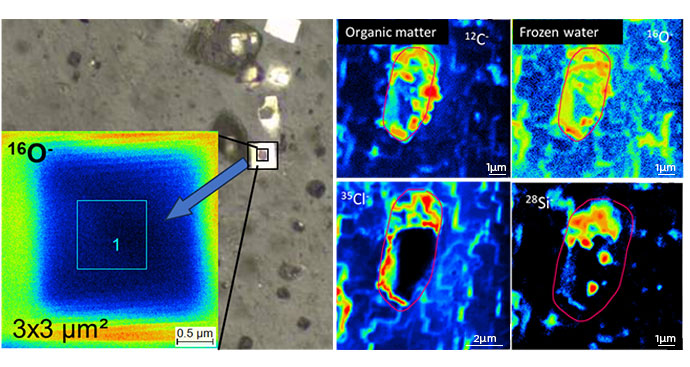 Figure 1: Elemental maps of halite inclusions
Depth profiling showed a sharp inversion in elemental signals at the inclusion boundary: high Cl and low O in the host mineral, transitioning to low Cl and high O within the inclusion. This pattern suggests the presence of multiple ice phases or exsolution effects, highlighting the internal complexity of the inclusions or the freerzing process in the analysis chamber. This phenomenon remains poorly understood and warrants further investigation by our scientific partners.
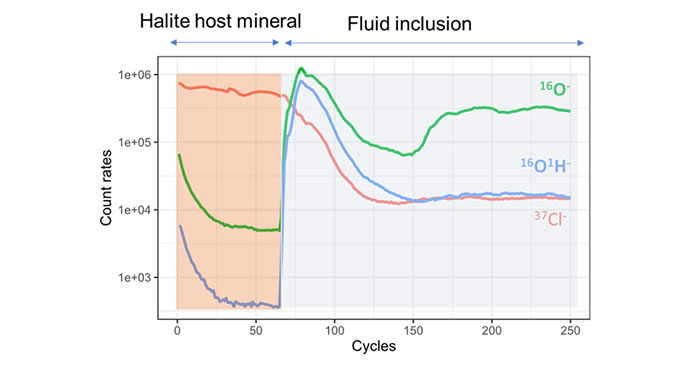
Figure 2: Depth profile across halite inclusion
Quantitative Isotopic Imaging in Chert
Sample Source: Museum National d’Histoire Naturelle (MNHN, France)
Host Mineral: Quartz
Inclusion Size: 1–10 µm
Objective: Measure δD and δ¹⁸O isotopic ratios in fluid inclusions
Using
NanoSIMS-HR with a cryogenic stage, the team obtained:
δ¹⁸O = +32 ± 5 ‰ (1 S.D.) with 3 pA Cs⁺ (~80 nm resolution)
δD = –364 ± 16 ‰ (1 S.D.) with 300 pA Cs⁺ (~600 nm resolution)
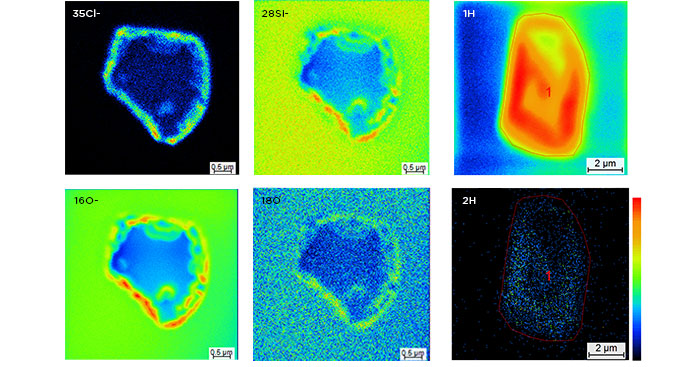 Figure 3: Isotopic maps of δ¹⁸O and δD in quartz inclusions
These results demonstrate the feasibility of quantitative isotopic imaging at the nanoscale. The precision achieved is sufficient to detect natural isotopic variations, making it possible to:
- Track the origin of fluids
- Identify mixing between distinct fluid sources
- Investigate geological processes at the microscale
Isotopic Imaging in Quartz
Sample Source: Japan Agency for Marine-Earth Science and Technology (JAMSTEC, Japan)
Host Mineral: Quartz
Inclusion Size: 1–10 µm
Objective: Perform quantitative isotopic imaging of fluid inclusions and host quartz
The team achieved ~50 nm lateral resolution images to extract the following composition and measured:
δ¹⁸O = +34 ± 4 ‰ in fluid inclusions
δ¹⁸O = +39.7 ± 3 ‰ in enclosing quartz
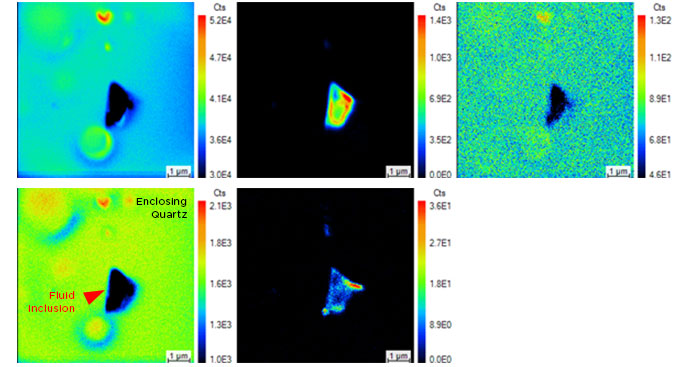
Figure 4: High-precision isotopic imaging of quartz inclusions
These values, though not corrected for instrumental mass fractionation, show that the precision achieved is better than the natural isotopic variation observed in terrestrial or extraterrestrial samples. This opens the door to:
- Differentiating between fluid sources
- Tracing isotopic evolution in geological and planetary environments
Overcoming analytical limitations with NanoSIMS-HR
The NanoSIMS-HR isn’t just a high-performance instrument – it is a gateway to previously inaccessible geochemical insights. With its ability to image features as small as 30 nanometers, detect elements at parts-per-billion levels, and simultaneously capture up to seven isotopic or elemental signals, it redefines what’s possible in fluid inclusion analysis.
These capabilities allow researchers to:
- Visualize the invisible: Submicron inclusions, once beyond analytical reach, can now be mapped in stunning detail.
- Decode complex histories: Isotopic variations within a single inclusion reveal stories of fluid mixing, phase changes, and geological evolution.
In short, NanoSIMS-HR transforms fluid inclusions from tiny mysteries into rich archives of Earth’s processes. Whether exploring ore genesis, climate proxies, or extraterrestrial samples, this technology empowers scientists to ask — and answer — questions at the nanoscale.
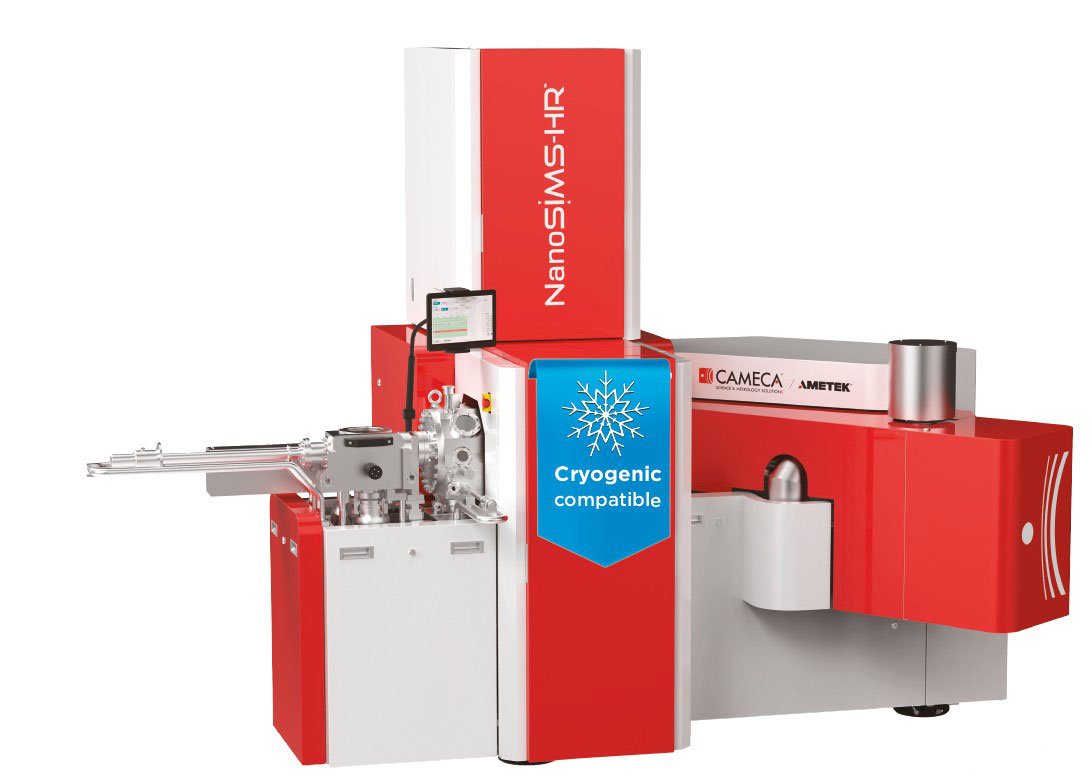
Figure 5: NanoSIMS-HR
Cryogenic sample stage for NanoSIMS-HR: Preserving frozen fluid inclusions for high-resolution Analysis
One of the most transformative innovations in the latest NanoSIMS-HR is the integration of a cryogenic stage, allowing researchers to analyze frozen fluid inclusions directly on thick petrographic sections — no melting, no chemical alteration, no compromise.
Maintained at temperatures as low as –140°C via a dedicated Dewar system, the cryo sample holder accommodates up to 9 samples of 10 mm diameter. This setup preserves the physical and chemical integrity of the inclusions, enabling high-resolution imaging and isotopic analysis that reflects their true geological history.
During the ECROFI 2025 conference, the presentation sparked engaging discussions, particularly around:
- Analysis duration: ~10 minutes to expose the inclusion surface by sputtering the host mineral, followed by ~20 minutes of signal acquisition in the inclusion.
- Lateral resolution: Down to tens of nanometers, revealing intra-inclusion heterogeneities previously undetectable.
- Precision: Sufficient to resolve natural isotopic variations in both terrestrial and extraterrestrial samples.
These discussions underscored a critical point: Cryogenic NanoSIMS-HR is currently the only technique capable of such localized, high-precision analysis in fluid samples — a breakthrough for geochemistry, planetary science, and beyond.
Cryogenic NanoSIMS-HR: scientific impact and future applications
The combination of NanoSIMS-HR and cryogenic capabilities marks a turning point in microanalytical science. It enables:
- Single fluid inclusion analysis with unprecedented spatial and isotopic resolution
- Detection of natural δD and δ¹⁸O variations in inclusions smaller than 2 µm
- Tracing the origin and evolution of fluids trapped in minerals — from deep Earth to Martian meteorites
This opens new avenues for:
- Understanding fluid-rock interactions in ore formation
- Reconstructing paleoenvironments and climate proxies
- Investigating planetary processes through extraterrestrial samples
The success of this project is the result of a close collaboration between CAMECA and leading researchers and institutions, to whom we extend our sincere thanks: Orsolya Gelencser (LRG), Csaba Szabo (LRG), Jérôme Aléon (MNHN), MoToo Ito (Jamstec).
To learn more you can read our application note: "Cryogenic Applications of NanoSIMS-HR: Isotopic Composition of Fluid Inclusions in Quartz"
DOWNLOAD APPLICATION NOTE
Collaborators of the project: Gelencser Orsolya (LRG), Szabo Csaba (LRG), Aléon Jérôme (MNHN), MoToo ITO (Jamstec)
Author: Laura CREON, Aurélien THOMEN, Céline DEFOUILLOY, Marc DEBLIQUI