The North China Craton, with its ancient granites and basalts, has long intrigued scientists studying the Earth’s geological history. A key question has persisted: where did the water in these granitic systems come from? In a groundbreaking study, Chuan-Mao Yang and his research team from the Guangzhou Institute of Geochemistry, Chinese Academy of Sciences (GIGCAS), used Large Geometry Secondary Ion Mass Spectrometry (LG-SIMS) to analyze D/H isotopes in apatite crystals. Their findings, recently published in Nature Communications, reveal new insights into the deep origin of water in these rocks, shedding light on water’s role in the formation of continental granites and basalts.
The Importance of Water in Granite Formation
Water plays a crucial role in the melting of continental crust, a key process in granite formation. However, pinpointing the exact source of water in these systems has been challenging. While previous studies linked water in continental arc granites to subducting slabs, the origin of water in intracontinental granites, such as those in the North China Craton, remained unclear. Large Geometry Secondary Ion Mass Spectrometry (LG-SIMS) was the essential technique that provided the answers.
Why LG-SIMS?
LG-SIMS offers unique advantages in isotope research, enabling high-precision analysis at microscopic scales. This capability to measure in situ hydrogen isotope compositions in apatite crystals is vital for differentiating between water sources. In the study by Yang et al., LG-SIMS was employed to measure hydrogen and oxygen isotopes, as well as water content, in apatite from late Mesozoic granites and basalts formed during the destruction of the North China Craton. These measurements are key to understanding how deep mantle water contributes to granite formation.
Precision Isotope Analysis: Analytical Parameters of LG-SIMS
Analyses were performed using a CAMECA LG-SIMS (IMS 1280-HR model) at the Guangzhou Institute of Geochemistry, Chinese Academy of Sciences (GIGCAS). A primary Cs+ beam current of few nA, rastered over a 15 × 15 μm2 area, and with an impact energy of 20 keV was used to sputter secondary ions from the samples.
In apatite samples, the 16O, 16O1H, 18O, 17O1H, 16OD signals were simultaneously counted in a single acquisition which was divided into 3 sequences. The value of mass resolving power (MRP) used to separate 16OD from 17O1H was set at 15,000. 17O1H was measured to check whether 17O1H and 16OD were well separated. Each measurement consisted of 16 cycles, with a total analysis time of approximately 12 minutes, including pre-analysis sputtering and peak centering.
The water content of apatite was determined from the measured 16O1H/16O ratio, and a calibration curve was constructed by the analyses of previously characterized two apatite standards, Kovdor apatite and Durango apatite. Corrections for instrumental mass fractionation (IMF) on hydrogen and oxygen isotopic compositions of apatite were performed using the Durango apatite standard and monitored by analyzing Qinghu apatite. The external precisions (i.e., reproducibility) of δD for Durango apatites are 21‰ (2SD, n = 16) and 37‰ (2SD, n = 18) in two alloy mounts. Both the internal and external precisions of δ18O are <1‰ (2SE or 2SD).
Key Findings from LG-SIMS Analysis
The LG-SIMS analysis revealed significant differences in hydrogen isotope values between Jurassic and Early Cretaceous granites. Apatites from Early Cretaceous granites and basalts showed extremely low δD values, suggesting a deeper water source, potentially the mantle transition zone (400 to 600 kilometers deep). As shown in Figure 1, the δD values of apatite from granites and basalts shift notably between the two periods, with Early Cretaceous samples displaying significantly lower values.
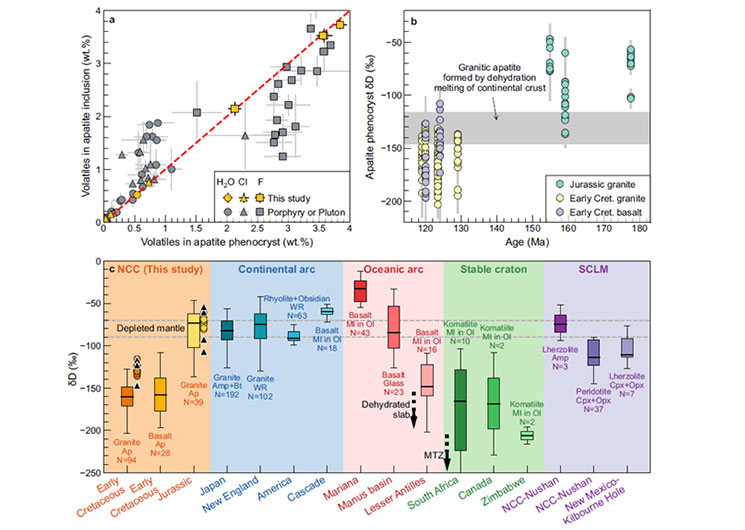
Figure 1: Volatile concentrations and hydrogen isotope compositions in apatite phenocrysts, inclusions, and hydrous minerals. (a) Relationships of volatile contents between apatite inclusions and phenocrysts. (b) Apatite δD values in granites and basalts over time. (c) Comparison of δD in apatite and hydrous minerals with values from continental and oceanic arcs and stable cratons..
In contrast, Jurassic granites had relatively higher δD values, indicating a shallower water source, likely from a subducting slab. This sharp decline in δD over time suggests a tectonic shift, with the Paleo-Pacific plate subducting deeper during the Early Cretaceous and releasing D-depleted water from the mantle. The δD versus δ18O plot (Figure 2) further supports the deep mantle origin of water in Early Cretaceous granites, as the apatites align with signatures of mantle-derived fluids.
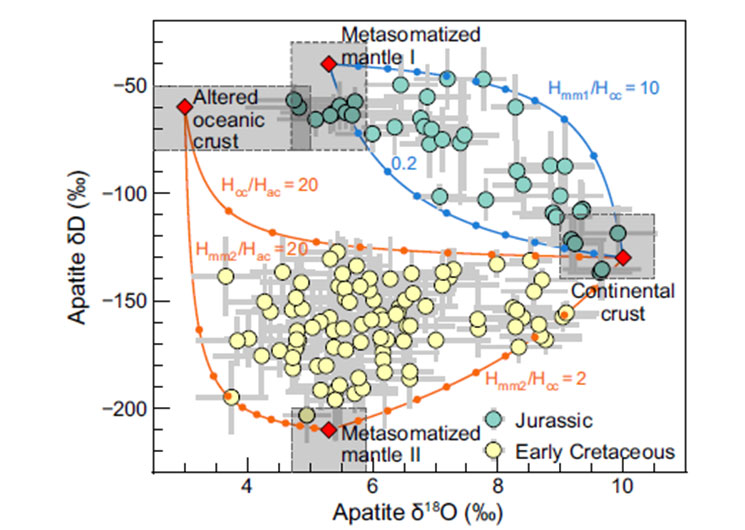
Figure 2: Plot of δD versus δ18O of apatite from Jurassic and Early Cretaceous granites in the North China Craton. The shaded fields depict isotope compositions of the continental crust, altered oceanic crust, and two metasomatized mantle components..
The Role of LG-SIMS in Future Research
This study demonstrates that LG-SIMS is a game-changer in tracing water origins in magmatic systems. Its ability to obtain isotopic data at microscopic scales, both with high spatial resolution and high precision, and for two isotopic systems such as H and O in this study, has proven invaluable for unraveling complex geological processes. With the insights gained from this study, LG-SIMS has expanded our understanding of how deep mantle water plays a critical role in granite formation.
Looking ahead, the use of LG-SIMS in geochemistry will continue to offer fresh perspectives on Earth's deep processes. As researchers apply this technology to other geological questions, it will undoubtedly lead to further discoveries about the dynamic interactions between Earth's crust, mantle, and the fluids that shape them.
Some words from the author, Chuan-Mao Y:
“Hydrogen isotopes in minerals can be influenced by a variety of complex geological processes. In-situ microanalysis, which uses minimal sample volumes to generate orders of magnitude more data than bulk analysis, is a powerful tool for studying these processes. Unlike extraterrestrial samples, which often exhibit extremely large hydrogen isotope fractionations (△D > 2000), terrestrial samples typically show much smaller fractionations (△D < 300). This requires high accuracy and mass resolution during analysis, making LG-SIMS almost the only viable option. One challenge with LG-SIMS is its relatively large sample chamber, which makes it difficult to achieve the ultra-high vacuum conditions necessary to minimize background water levels. To address this, we developed Sn-Bi alloy mounts and an automatic cooling system, significantly improving the vacuum level to the order of 10-10 mbar. These advancements have greatly enhanced our ability to accurately measure hydrogen isotopes in geological samples. See the featured paper selected by Nature Communications Editors: Chuan-Mao Yang et al. 2024, Light δD apatites reveal deep origin water in North China Craton intracontinental granites and basalts, Nature Communications, https://doi.org/10.1038/s41467-024-53133-4
References:
Piani, L. et al. 2018. A dual origin for water in carbonaceous asteroids revealed by CM chondrites. Nature Astronomy, https://doi.org/10.1038/s41550-018-0413-4
Hauri, E. et al. 2006, Matrix effects in hydrogen isotope analysis of silicate glasses by SIMS, Chemical Geology, https://doi.org/10.1016/j.chemgeo.2006.08.010
Hauri, E. et al. 2002, SIMS analysis of volatiles in silicate glasses: 1. Calibration, matrix effects and comparisons with FTIR, https://doi.org/10.1016/S0009-2541(01)00375-8
Deloule, E., & Robert, F. 1995, Interstellar water in meteorites? Geochimica et Cosmochimica Acta, https://doi.org/10.1016/0016-7037(95)00313-4
Deloule, E. et al. 1991, Hydrogen isotope heterogeneities in the mantle from ion probe analysis of amphiboles from ultramafic rocks. E.P.S.L, https://doi.org/10.1016/0012-821X(91)90191-J
Authors: Paula PERES (Applications Manager), Laura Creon (xf and LG-SIMS Product Manager)