Why Batteries? Why APT?
Right now, I am typing away at this blog post (my very first one for CAMECA!) on a laptop at the airport. No plugs in sight! But do you know what is great? I can still get work done due to the battery power. Think about how many things you touch every day that rely on battery power. Most folks would say their phone for sure, but also think about electric cars, ebikes, home electronics and more! For materials that are such an integral part of modern life, it’s worth it to take a bit of time to think about how they operate, and ultimately how they can be better. Each lithium ion battery contains a cathode, anode, and electrolyte material, ions can move between the anode and cathode. The lithium does the work of moving from the anode to the cathode when it undergoes discharge, and the reverse cycle when charging. The cathode materials are typically oxides containing Li and Co as a powder packed within a binder. Some materials for higher power applications like electric cars contain nickel magnesium cobalt alloys in particular NixMnyCoZ ratios, with the XYZ numbers indicating a particular stoichiometry.
What makes analysis of lithium ion batteries challenging? The lithium distribution and concentration is clearly a critical component of how batteries operate. But as we know, lithium is a light (low atomic weight) element. Compositional analysis techniques like STEM-EDS, rely on x-rays to calculate the composition. For lithium this can pose a particular challenge, as light-element x-rays are often absorbed by the material and not detected. Atom probe tomography (APT) is equally sensitive to all elements in the periodic table, so the presence of Li does not pose an issue for APT. I’d like to show you how APT can make a strong impact to understanding the chemistry and structure for materials like NMC 622 and NMC 811, two of the very common powders used for high power lithium ion battery applications.
Stoichiometry and Structure from APT data
The first question we often get from customers is how to prepare a sample from these powder-based materials, as APT often relies on having a solid needle-shaped specimen geometry? That one is easy: pretty much the same way as any bulk material by using a focused ion beam (FIB). The secondary particles are made up of smaller primary particles and are generally five to 20 µm in diameter. We can apply the standard simple top-down specimen preparation methodology to create atom probe samples as shown in Figure 1.
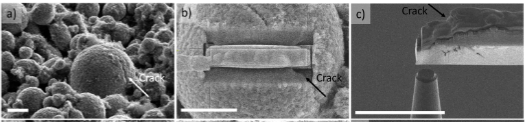 Figure 1: (a): Secondary particle, arrow pointing to a large crack in the particle, (b) liftout bar from the particle surface, (c) wedge ready for mounting on a microtip coupon post. Scale bars are all 5 µm. Adapted from [1].
Atom probe data can show us many things about microstructure and composition, so I will give you two examples of how APT can make an impact in battery materials analysis. The first is by determining the stoichiometric composition and metal ratios for some commonly used battery powders, nominally 622 and 811. Figure 2 shows the bulk compositional analysis results from several analyzed particles of NMC 622, showing good agreement with the expected stoichiometric ratios for Ni, Mn, and Co.
Another way composition is typically reported for batteries is by comparing the metal/oxide and lithium ratios, because that can be indicative of phase transformations. This can be a challenging measurement for other techniques like EELS because of overlap Li and Co signals [2]. Figure 2 shows the O:Li:Metal ratio for 11 atom probe datasets from NMC 811, showing an approximate average ratio of 1.9 O: 1.2 Li: 1.0 (Ni, Co, Mn), in good agreement with the expected 2:1:1 ratio.
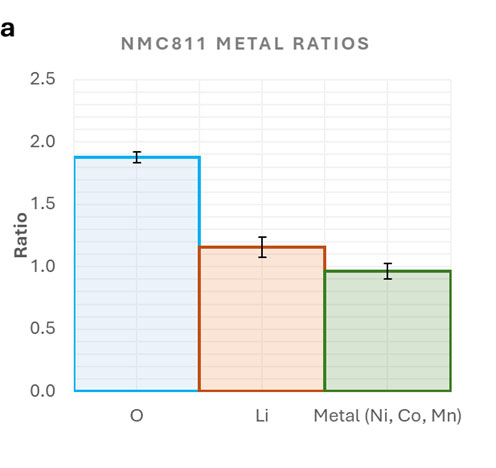
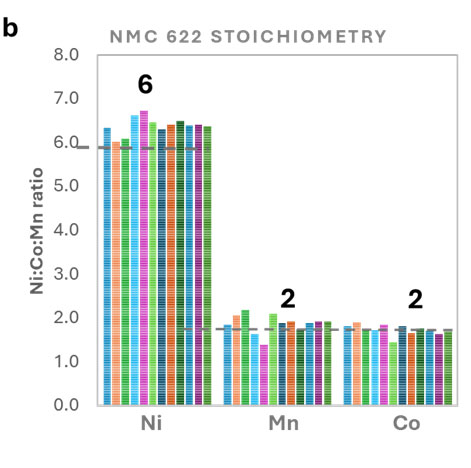 Figure 2 a) compositional ratios of O:Li: (Ni, Co, Mn) for NMC 811, (b), compositional ratios of Ni:Mn:Co for NMC 622. Both show good agreement with expected compositions. Adapted from [1]
Secondly, atom probe data brings true 3D characterization and visualization of the microstructure of primary particles which completes the picture of how lithium may be segregating along boundaries of the primary particles, ultimately affecting the properties. Figure 3 shows the 3D reconstruction of NMC 622, with a region delineated by a 40 at % Li isoconcentration surface. Note that a grain boundary is observed with significant Al segregation, which may positively influence the ability of Li to intercalate both within and between primary particles, leading to improved battery performance. Bulk techniques such as EDS or EELS provide valuable complementary information, but may miss out on the chemical-structural relationship that can help materials scientists gain insight into the performance and degradation of Li ion batteries.
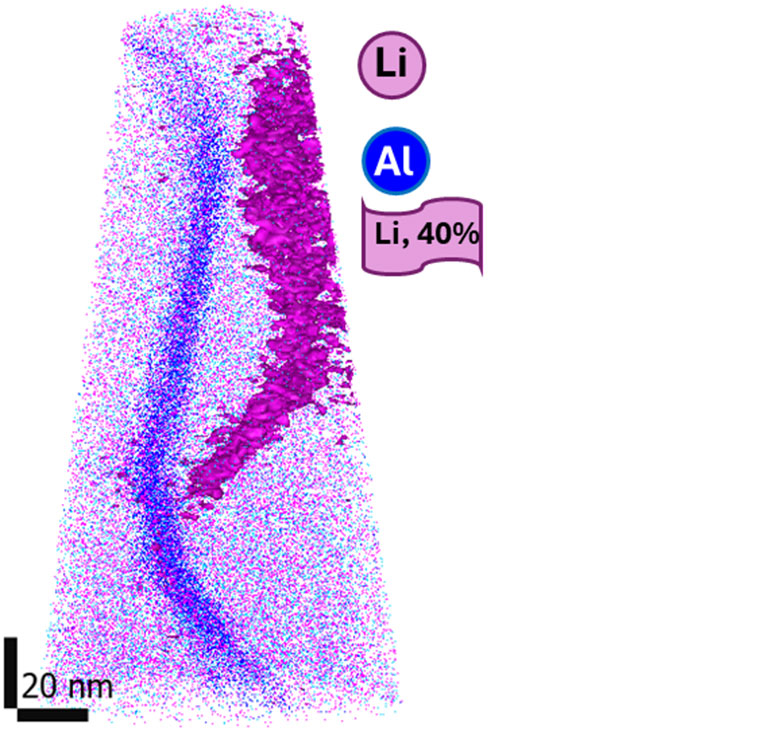 Figure 3: Ion map image of NMC 622 with Li, Al ion displayed and a 40% isoconcentration surface. Adapted from [1].
The equal sensitivity to light elements like Li, the three-dimensional nature, and the nanoscale capabilities of Atom probe tomography make it a perfect technique for Li ion battery material investigation. There is plenty of great work being done in the area of battery analysis with the atom probe, both by CAMECA and from our customer base. For more information, check out some references below, particularly the book chapter on battery analysis with atom probe from CAMECA’s own Dr. Yimeng Chen.
Chen, Y. Atom Probe Tomography. in Microscopy and Microanalysis for Lithium-Ion Batteries (CRC Press, 2023).
Wang, Z. et al. In Situ STEM-EELS Observation of Nanoscale Interfacial Phenomena in All-Solid-State Batteries. Nano Lett. 16, 3760–3767 (2016).
Quantification and Chemical Fluctuation in NMC Li-ion Battery Cathode Materials Analyzed Using APT, MRS Special issue, in press
Kim, S.-H. et al. Atom probe analysis of electrode materials for Li-ion batteries: challenges and ways forward. J. Mater. Chem. A 10, 4926–4935 (2022).
Authors: Katherine RICE (Atom Probe Tomography Applications Lab Manager)
Other Participants/Contributors: Yimeng Chen (Applications Scientist)