
From Implant to Insight: How Dynamic SIMS Supports Ion Implantation Process Control
Ion implantation is a key process in semiconductor manufacturing, enabling precise control of dopant concentration and distribution. But achieving the targeted implant is only part of the challenge: manufacturers also need to verify where the dopants are, how deeply they extend, and at what concentration.
This is where Dynamic Secondary Ion Mass Spectrometry (SIMS) plays a key role.

CAMECA recently contributed a section on Dynamic SIMS and dopant analysis to the new Springer book Ion Implantation and Annealing Applications, Science and Technology: Contributions from IIT School, Edition 2026. The contribution, included in Chapter 6 on metrology for ion implantation and annealing process control, covers SIMS fundamentals, instrumentation, depth profiling, imaging, quantification and practical analytical challenges.
Why SIMS for ion implantation?
Dynamic SIMS combines high sensitivity with excellent depth and lateral resolution. It can detect nearly all elements and isotopes and is particularly well suited to measuring trace elements such as dopants in ion-implanted materials.
During a SIMS measurement, a primary ion beam bombards the sample surface and progressively sputters material. A fraction of the sputtered species is ionized, producing secondary ions that are collected and analyzed by a mass spectrometer.
A single SIMS depth profile provides several key parameters for implant characterization and process control:
- the dopant distribution as a function of depth
- the projected range (Rp)
- the maximum dopant concentration (Cp)
- the implanted dose
- the dynamic range and detection limit.
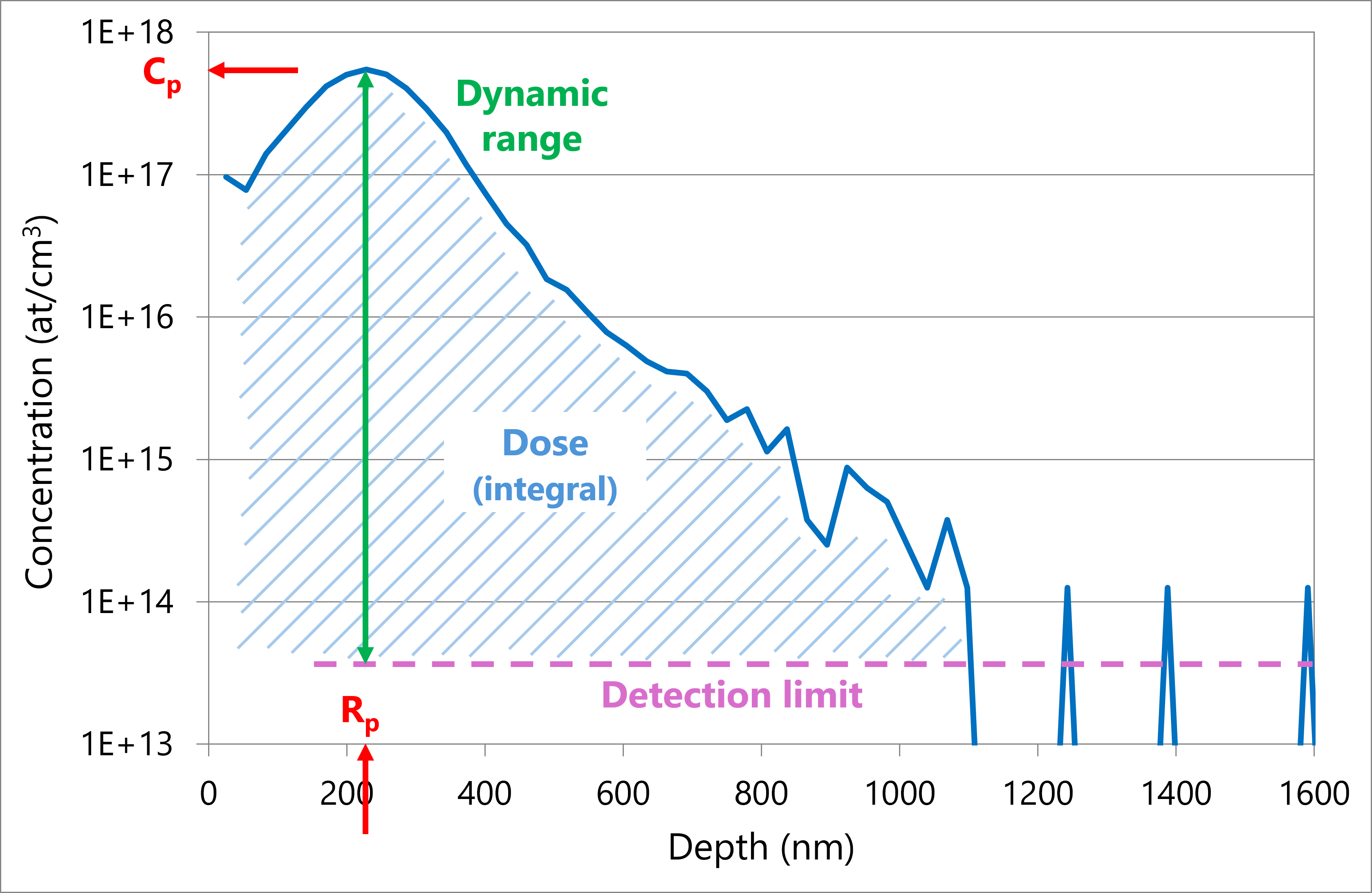
Typical SIMS depth profile of an ion-implanted sample, illustrating Cp, Rp, implanted dose, dynamic range and detection limit.
From deep implants to nanoscale imaging
Different implant challenges call for different SIMS configurations and analytical conditions. The IMS 7f-Auto is a versatile, high-performance instrument for depth profiling across a broad range of applications, including deep implants and light-element analysis, while the IMS Wf / SC Ultra provides the very low impact energies required for ultra-shallow profiling. When the question shifts from depth distribution to nanoscale lateral distribution, NanoSIMS-HR extends SIMS characterization into high-resolution elemental imaging.
For routine implant monitoring and deeper profiles, higher impact energies provide high sputtering rates while maintaining excellent sensitivity. On the CAMECA IMS 7f-Auto, automated measurements can combine low detection limits, high throughput and excellent repeatability, making the instrument particularly well suited to implant process control.
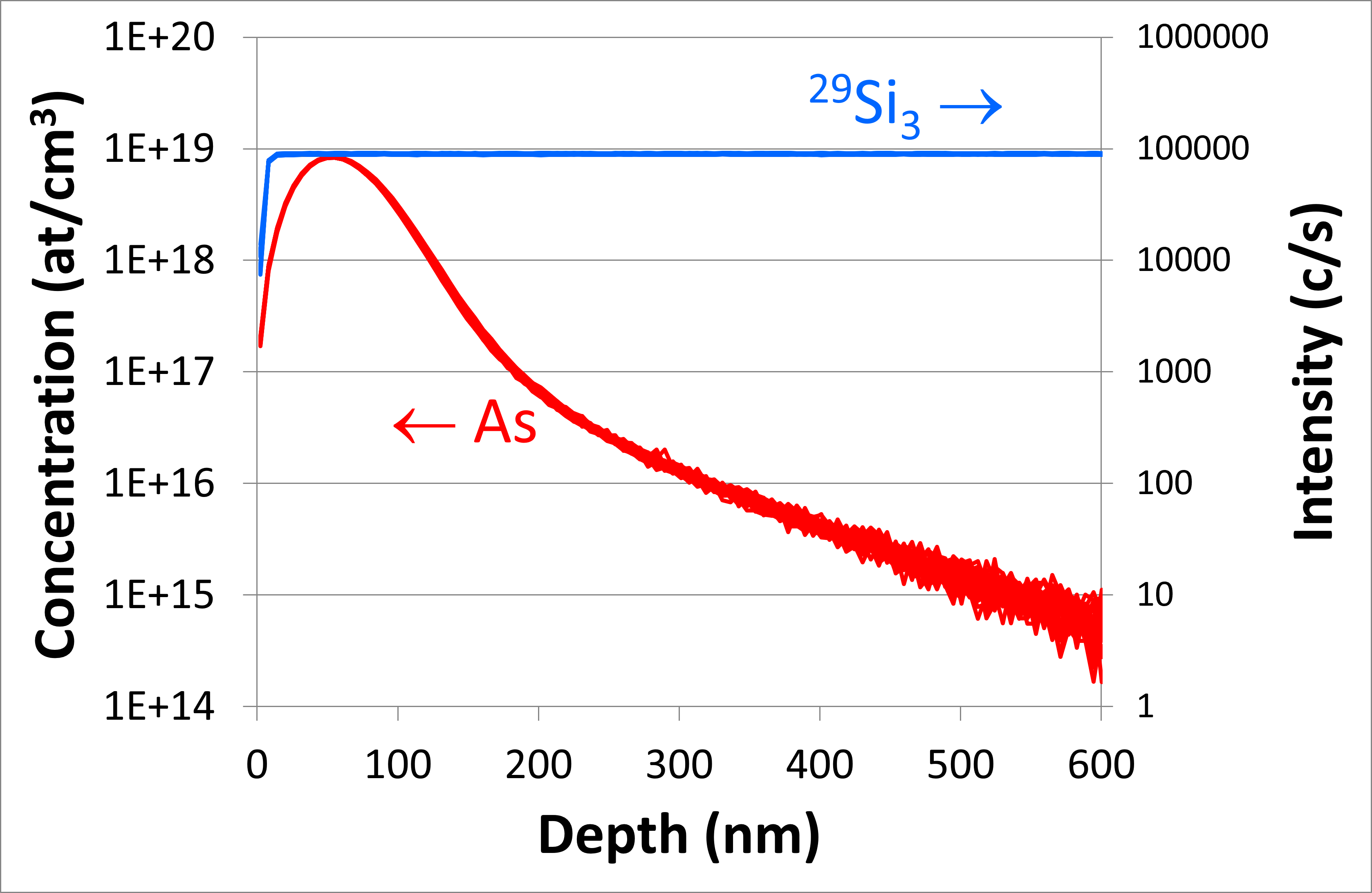
Overlay of 36 SIMS depth profiles of an arsenic implant in silicon using 15 keV impact energy. Measurements on 12 samples demonstrate high throughput and excellent repeatability, with an RSD of 0.46 % for implant dose measurement. Total analysis time: 5h30min (36 runs). Data collected on a CAMECA IMS 7f-Auto.
Beyond routine implant depth profiling, SIMS can also provide lateral and three-dimensional elemental information.
Depending on the instrumentation, SIMS imaging can cover fields of view ranging from hundreds of micrometers down to a few micrometers. CAMECA IMS platforms provide lateral resolution in the micrometer range, while the NanoSIMS-HR extends SIMS imaging to the nanoscale, with lateral resolution down to 30 nm.
For semiconductor applications, SIMS imaging opens possibilities for investigating dopant distributions in patterned devices, defects in advanced CMOS structures and implantation uniformity in power devices.
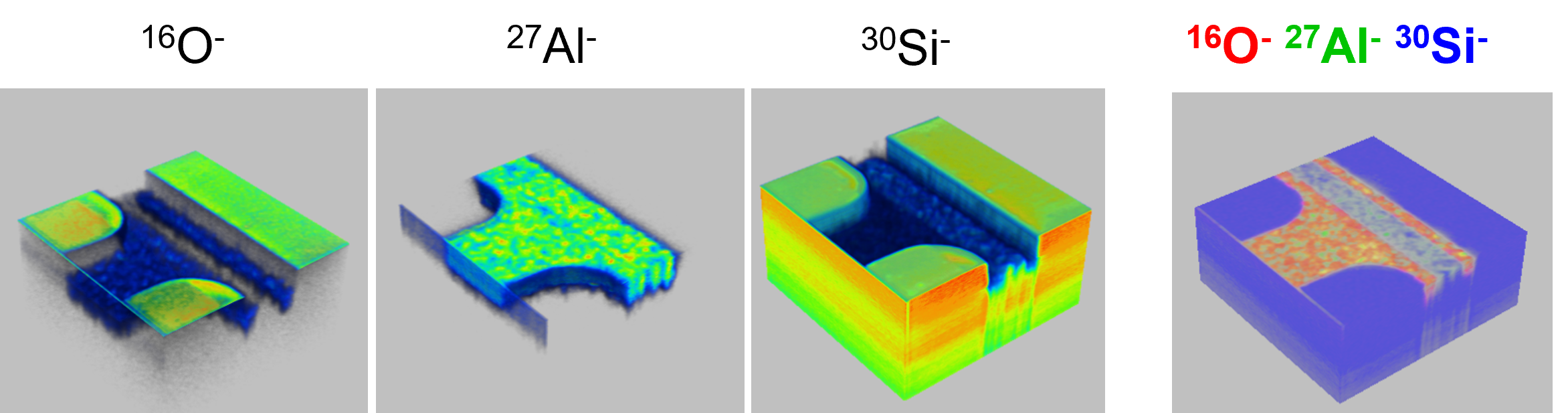
3D volume reconstruction of a sequence of 16O, 27Al, 28Si SIMS images in a piezoresistive pressure sensor. An RGB overlay of the SIMS 3D images for the three species is shown on the right. Field of view: 120 × 120 µm2 (X-Y). Total depth: 2.3 µm (Z). Sample courtesy of Hartmuth Struzberg, CIS (Germany). Data collected on a CAMECA IMS 7f-Auto.
From ion counts to quantitative implant profiles
A SIMS profile becomes particularly valuable for process control when signal intensity can be converted into concentration versus depth. This requires two complementary calibrations:
- Depth calibration, converting sputtering time into depth.
- Concentration calibration, typically based on a Relative Sensitivity Factor (RSF) determined using an appropriate reference standard.
Ion-implanted reference materials are particularly well suited to this purpose because the implant dose provides a reference for quantitative calibration.
Addressing real-world analytical challenges
Implant analysis is not always straightforward. Matrix effects, low ionization yields, molecular interferences and background signals can make some dopants particularly challenging to measure.
One example is the analysis of nitrogen in silicon carbide (SiC), an important dopant for n-type SiC. Because nitrogen has a very low ionization yield, higher sensitivity can be achieved by detecting the 14N12C- molecular ion. A mass resolving power of approximately 8,000 is required to separate molecular interferences. Optimized vacuum and analytical conditions are also essential to minimize background contributions from residual gases in the analysis chamber.
These examples illustrate why successful SIMS analysis relies not only on sensitivity, but also on selecting the appropriate secondary ion species, mass resolution and analytical protocol.
From implant to insight
From deep implants to ultra-shallow junctions and nanoscale elemental imaging, Dynamic SIMS provides the sensitivity, depth resolution and quantitative information needed to understand implanted dopant distributions.
CAMECA's dynamic SIMS portfolio provides complementary solutions across these applications: high-throughput implant profiling with the IMS 7f-Auto, ultra-shallow profiling with IMS Wf/SC Ultra, and nanoscale elemental imaging with NanoSIMS-HR.
CAMECA's contribution to the new IIT School reference book brings these capabilities together, from SIMS fundamentals to practical dopant analysis and ion implantation process control.
Want to learn more?
👉 Discover the Springer book: Ion Implantation and Annealing Applications, Science and Technology: Contributions from IIT School, Edition 2026
👉 Learn more about SIMS: CAMECA's SIMS Overview
Author: Paula Peres (Applications Manager)
